
Key Insight: The hidden costs of toxic clients — leadership time, team morale impact, stress-related turnover risk, and opportunity cost — often far exceed the revenue they generate.
The Revenue That Costs More Than It Pays
Early in my career, I held onto clients I should have let go because I was afraid of losing the revenue. I watched those clients drain my team's energy, consume my leadership attention, and create a culture of anxiety that affected everyone around them.
The lesson I learned — and relearned several times before it fully sank in — is this: not all revenue is good revenue.
Some clients cost more than they pay. Not just in direct costs, but in the hidden costs that are harder to measure: the team morale that erodes when people dread coming to work, the leadership energy spent managing complaints instead of building the business, the opportunity cost of not pursuing better clients because your capacity is consumed by difficult ones.
Firing a toxic client is not a failure. It is a values-based business decision that protects your team, your culture, and your long-term growth.
The Signs of a Toxic Client
Not every difficult client is a toxic client. Difficult clients push back, ask hard questions, and hold you to high standards. These are often the clients that make you better.
Toxic clients are different. Here are the clear signs:
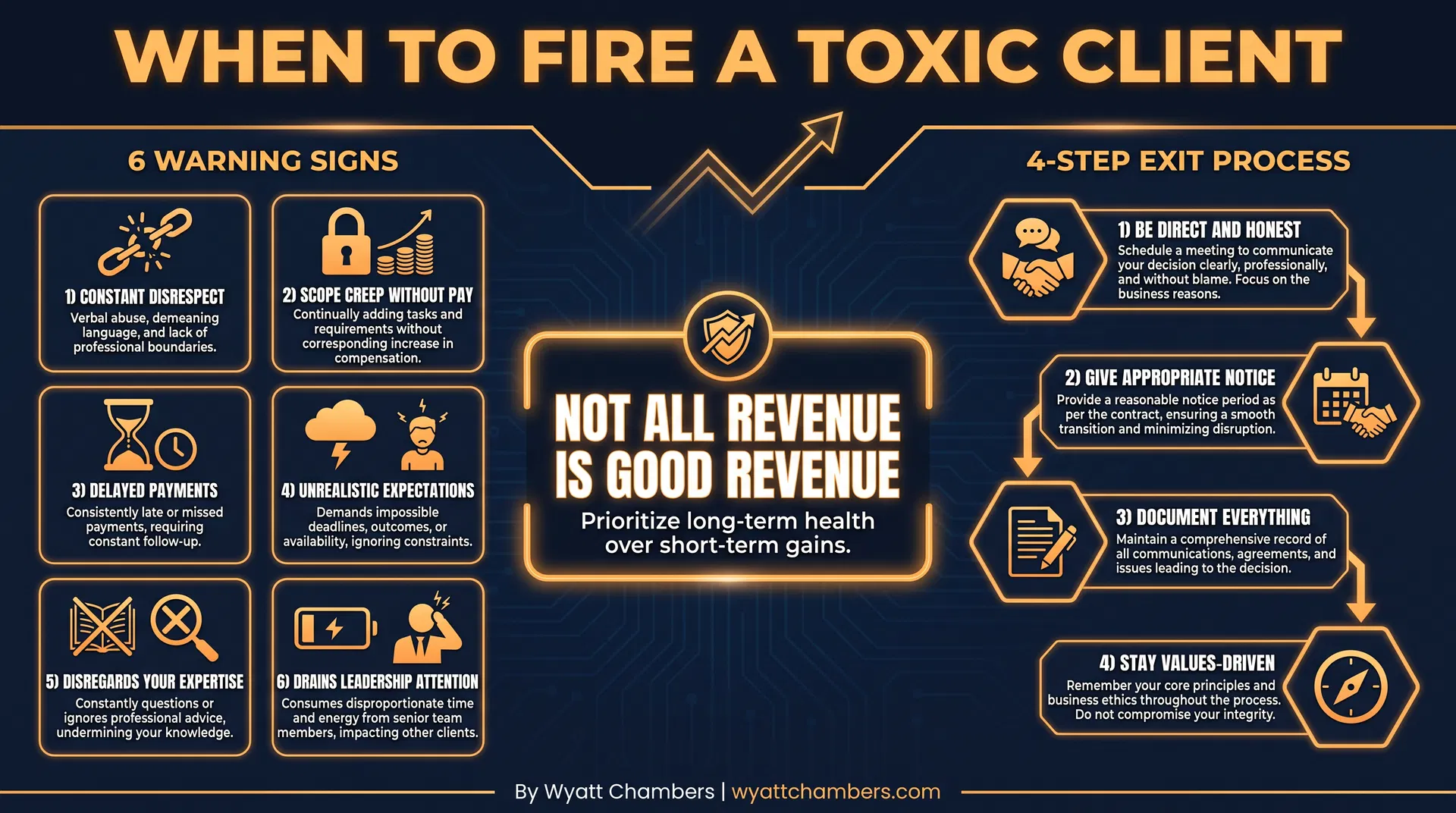
Consistent disrespect. They speak to your team members dismissively, make unreasonable demands, and treat your people as if their time and expertise have no value.
Scope creep without compensation. Every project expands beyond its original scope, and every attempt to address this is met with resistance, guilt-tripping, or threats.
Delayed or disputed payments. They consistently pay late, dispute invoices without legitimate cause, or use payment as leverage.
Unrealistic expectations. No matter what you deliver, it is never enough. The goalposts move constantly, and the standard of success is always just out of reach.
Disregard for your expertise. They hired you for your expertise but consistently override your recommendations, then blame you for the results.
Disproportionate consumption of leadership attention. You find yourself spending hours each week managing this one client relationship — time that could be invested in growing the business or serving clients who value what you do.
Team impact. Your team members dread interactions with this client. You hear complaints about them in team meetings. People are visibly stressed by the relationship.
The Business Case for Firing Toxic Clients
The business case is straightforward once you do the math:
Direct cost: The revenue from the toxic client, minus the direct costs of serving them.
Hidden costs: Leadership time, team morale impact, stress-related turnover risk, opportunity cost of capacity consumed by this client.
Opportunity cost: What could you do with the time, energy, and capacity currently consumed by this client? What better clients could you serve? What growth initiatives could you pursue?
In almost every case I have seen, when business owners do this math honestly, the toxic client is either marginally profitable or actually unprofitable when all costs are accounted for.
How to End the Relationship Professionally
Ending a client relationship professionally is important — both for your reputation and for your own values. Here is how to do it:
Be direct and honest. Do not make up reasons or be vague. A clear, professional explanation — focused on fit rather than blame — is more respectful than a fabricated excuse.
Give appropriate notice. Depending on your contract and the nature of the work, provide a reasonable transition period. This demonstrates professionalism and gives the client time to find an alternative.
Document everything. Follow up the conversation in writing. Ensure all contractual obligations are met and clearly documented.
Stay calm and values-driven. No matter how the client reacts, maintain your composure and your values. How you end relationships says as much about your character as how you begin them.
Do not burn bridges. Even toxic clients have networks. End the relationship with dignity and professionalism, and let your conduct speak for itself.
The Relief on the Other Side
Every business owner I know who has made the decision to end a toxic client relationship has said the same thing afterward: "I should have done that sooner."
The relief — for you and for your team — is immediate. The energy that was being consumed by the difficult relationship becomes available for better things. The culture of the team improves. The space created by ending the bad relationship is almost always filled by better opportunities.
Not all revenue is good revenue. The clients you choose to work with define your culture, your team's experience, and the kind of business you are building. Choose wisely.