
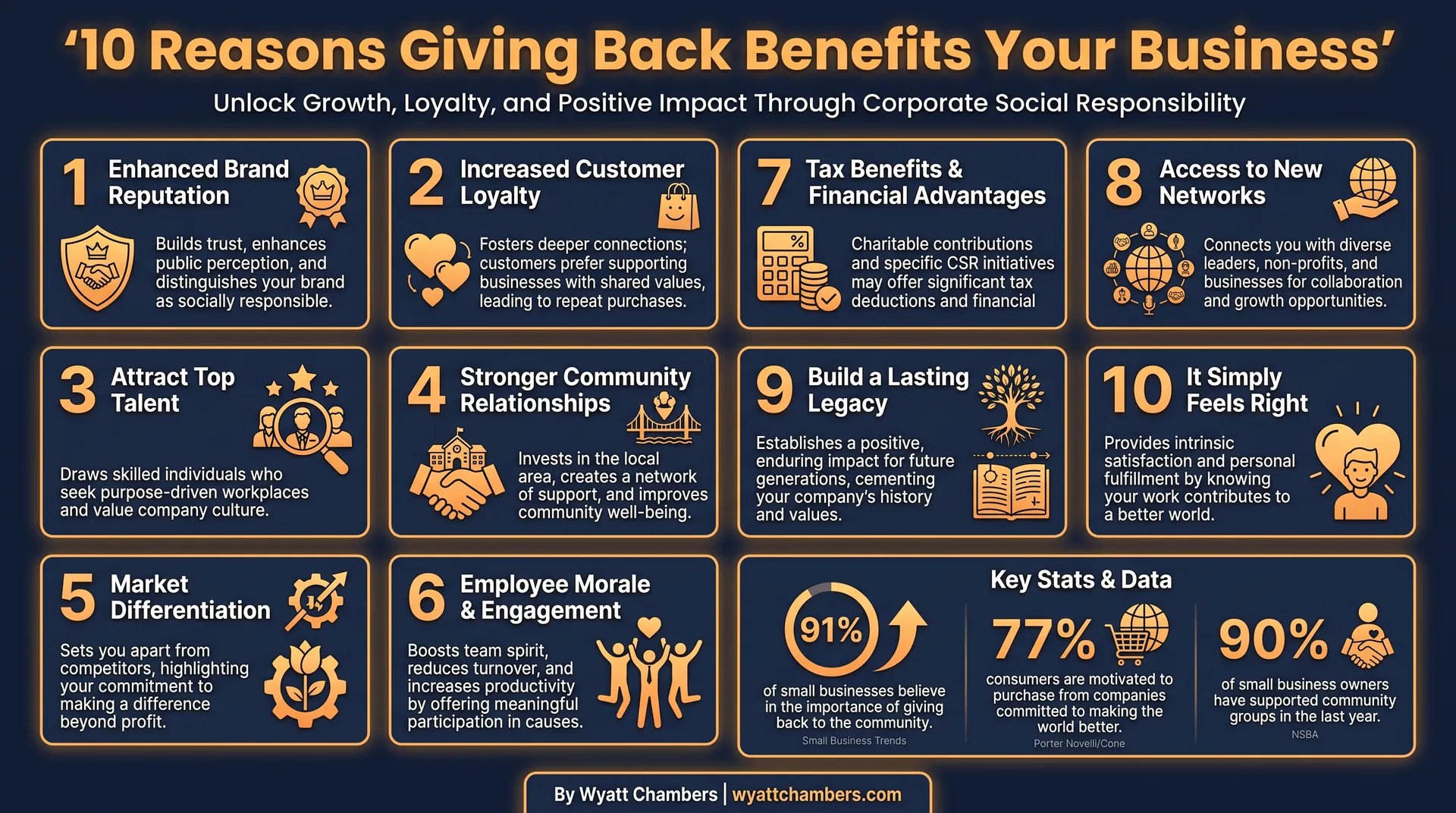
Key Stats: 91% of small businesses believe businesses should give back | 77% of consumers want to buy from companies making the world better | 90% of small business owners have financially supported community groups | 76% of small business owners have volunteered their time
Why Giving Back Is Not Optional Anymore
I serve as a Board Member of Whisker Mountain, a non-profit organization here in Arizona. I volunteer time to community organizations. CS Design Studios and SWARM Pest Control Marketing both have community giving built into how we operate.
This is not charity. It is strategy.
The data on community giving and business performance is unambiguous: 91% of small businesses believe businesses should give back to their local communities. 77% of consumers want to buy from companies making the world better. 90% of small business owners have financially supported community or civic groups.
The businesses that are winning in their local markets are not just the ones with the best products or the most aggressive marketing. They are the ones that are woven into the fabric of their communities — the ones that people feel proud to support because they know the business is giving back.
Here are the 10 reasons why giving back makes business sense.
10 Reasons Giving Back Benefits Your Business
1. Enhanced Brand Reputation
Your brand is not what you say about yourself. It is what your community says about you. And communities talk about businesses that show up for them.
When your business sponsors a local event, supports a school, or contributes to a cause that matters to your community, you build the kind of brand equity that no advertising campaign can buy. People remember who showed up.
2. Increased Customer Loyalty
Customers who share your values become advocates, not just buyers. When you demonstrate a genuine commitment to community, you create an emotional connection with your customer base that goes beyond the transactional.
These customers stay longer, spend more, and refer more. They become part of your story, and you become part of theirs.
3. Attracting and Retaining Top Talent
The best employees want to work for companies that stand for something. Especially among younger generations, the values and social impact of a business are significant factors in employment decisions.
When your business has a visible, genuine commitment to community giving, you attract people who share those values — and those people tend to be exactly the kind of employees you want.
4. Stronger Community Relationships
Business success is built on relationships. And the deepest, most durable business relationships are built in the context of shared community investment.
When you serve on a non-profit board, volunteer at a community event, or sponsor a local initiative, you build relationships with other community leaders — relationships that often generate business opportunities, partnerships, and referrals that would never emerge through traditional networking.
5. Differentiation in a Crowded Market
In most markets, the functional differences between competitors are relatively small. What creates genuine differentiation is character — the values, culture, and community presence of a business.
When you are known as the business that gives back, you occupy a unique position in the minds of your customers and community. That position is very difficult for competitors to replicate.
6. Improved Employee Morale and Engagement
Employees who are proud of where they work are more engaged, more productive, and more likely to stay. Community giving programs — especially those that involve employees directly, like volunteer days or matching donation programs — create shared experiences that strengthen team culture and increase engagement.
7. Tax Benefits
Community giving, whether through direct donations, sponsorships, or in-kind contributions, often creates meaningful tax benefits for businesses. While this should not be the primary motivation, it is a real financial benefit that reduces the net cost of giving.
8. Access to New Networks
Non-profit boards, community organizations, and civic groups bring together leaders from across industries and sectors. Serving in these contexts exposes you to relationships and opportunities that would be difficult to access through traditional business networking.
Some of the most valuable relationships I have built in my career came through community involvement, not business events.
9. Building a Legacy
At some point in every business owner's journey, the question shifts from "how do I build a successful business?" to "what kind of impact do I want to have?" Community giving is how you start building the answer to that question.
The businesses that endure across generations are the ones that are genuinely embedded in their communities — the ones that people fight to protect and support because they have been fighting for the community for years.
10. It Feels Right
I put this last, but it might be the most important. Giving back feels right. It aligns with the values that most business owners hold — values of service, contribution, and making a difference.
When your business is aligned with your values, you show up differently. You lead differently. You make decisions differently. And that alignment creates a kind of energy and authenticity that customers, employees, and partners can feel.
How to Start
If you are not currently involved in community giving, start small. Pick one organization that aligns with your values and make a meaningful commitment — whether that is financial support, board service, or volunteer time.
Be consistent. Show up. Let your involvement be genuine rather than performative.
Over time, your community giving will become one of the most important parts of your brand, your culture, and your legacy.