
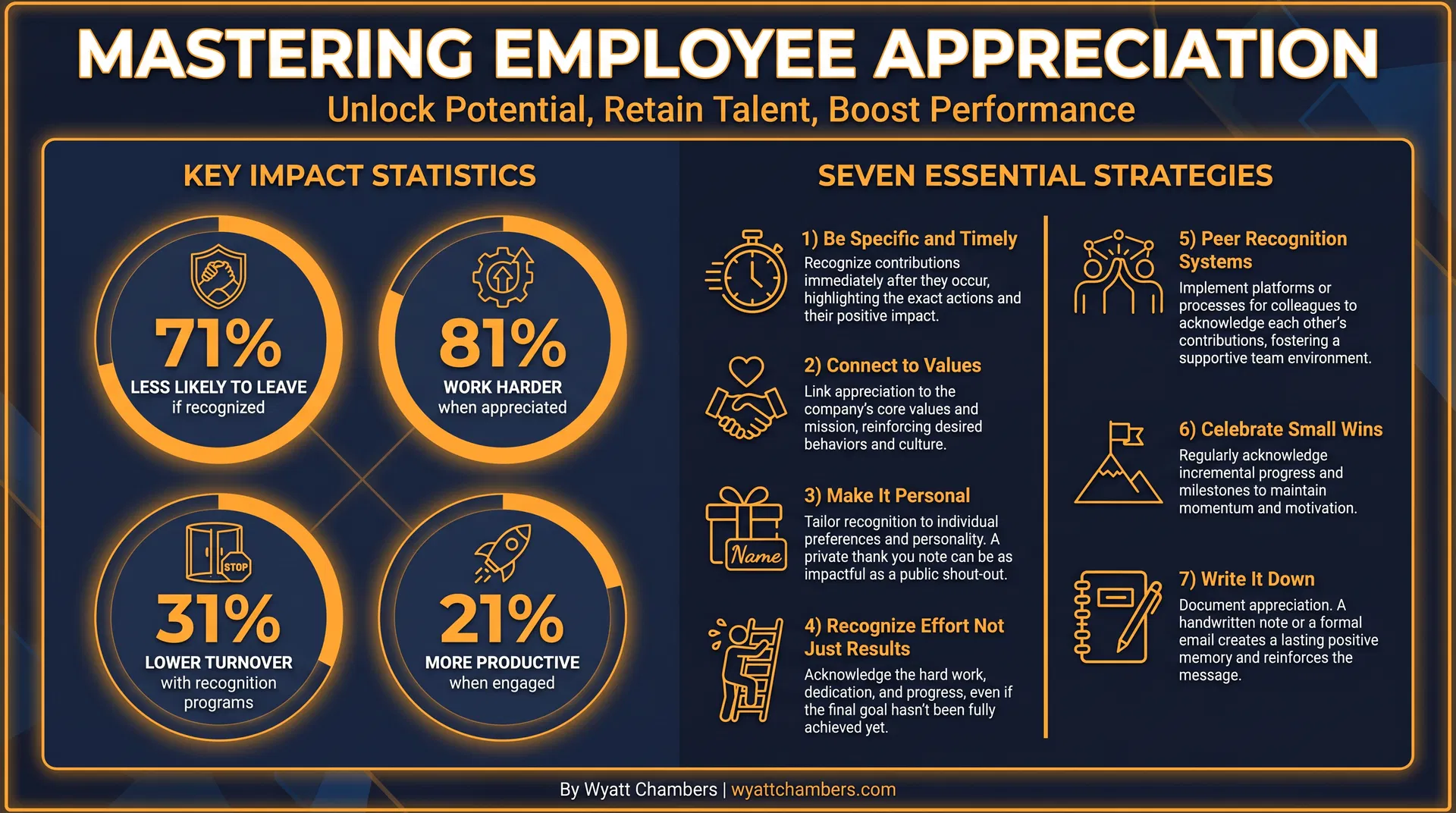
Key Stats: 71% of employees would be less likely to leave if recognized | 81% of workers feel motivated to work harder when appreciated | Organizations with recognition programs have 31% lower voluntary turnover | Engaged employees are 21% more productive and 22% more profitable
The Recognition Gap
Here is a question every business owner should sit with: when did you last tell a team member specifically what they did well and why it mattered?
Not a generic "good job." A specific, genuine acknowledgment of a specific contribution.
If you are struggling to remember, you are not alone. Most business owners are so focused on what needs to be fixed, improved, or grown that they consistently underinvest in recognizing what is already working — and the people making it work.
The cost of this gap is enormous:
- 71% of employees would be less likely to leave if they were recognized
- 81% of workers feel motivated to work harder when their manager shows appreciation
- Organizations with effective recognition programs have 31% lower voluntary turnover
- Engaged employees are 21% more productive and 22% more profitable
Recognition is not a nice-to-have. It is a high-ROI business strategy.
Why Most Recognition Fails
Before we talk about what works, it is worth understanding why most recognition efforts fall flat.
Generic recognition. "Great job this week" means almost nothing. Specific recognition — "The way you handled that client situation on Tuesday, staying calm and finding a creative solution, is exactly the kind of problem-solving that makes this team exceptional" — means everything.
Delayed recognition. Recognition that comes weeks or months after the fact loses most of its impact. The most powerful recognition is timely — as close to the moment of the behavior as possible.
Inauthentic recognition. People can tell when appreciation is genuine versus performative. If you are recognizing someone because you feel obligated to, they will feel that. Recognition must come from a place of genuine gratitude and respect.
One-size-fits-all recognition. Different people feel appreciated in different ways. Some people love public recognition. Others find it embarrassing and prefer a private acknowledgment. Understanding how each person on your team receives appreciation is essential.
Seven Strategies for Meaningful Recognition
1. Be Specific and Timely
The most powerful recognition is specific and immediate. When you observe a behavior or outcome worth recognizing, acknowledge it as soon as possible with specific details about what you observed and why it mattered.
"I noticed how you stayed late to help the new team member get up to speed last week. That kind of generosity is what makes our culture what it is, and I want you to know I see it and I am grateful for it."
2. Connect Recognition to Values
Recognition is most meaningful when it connects individual behavior to the values and mission of the organization. This reinforces what the culture stands for and makes the employee feel like their contribution matters beyond their individual role.
3. Make It Personal
Take the time to understand how each team member prefers to receive recognition. Some people love being called out in a team meeting. Others prefer a private conversation or a handwritten note. The effort you invest in personalizing recognition signals that you actually know and care about the person.
4. Recognize Effort, Not Just Results
In a results-driven business culture, it is easy to only recognize outcomes. But some of the most important contributions — the extra effort, the creative problem-solving, the support offered to a struggling colleague — do not always show up in the metrics.
Recognizing effort and values-aligned behavior, not just results, builds a culture where people feel safe to try, fail, and grow.
5. Create Peer Recognition Systems
Recognition does not have to come only from leadership. Peer recognition programs — where team members can acknowledge each other's contributions — create a culture of appreciation that is self-reinforcing and does not depend on a single leader to sustain.
6. Celebrate Small Wins
Most leaders wait for the big wins to celebrate. But the small wins — the incremental progress, the problems solved, the relationships maintained — are what add up to the big outcomes.
Celebrating small wins keeps momentum high, reinforces positive behavior, and creates a culture where progress is valued, not just results.
7. Write It Down
A handwritten note of appreciation is one of the most powerful recognition tools available to any leader, and one of the least used. In a world of digital communication, a physical, handwritten note signals that you took time and care — and it is something people keep.
The Culture You Build Through Recognition
The way you recognize your team is a direct expression of your values as a leader. When you consistently acknowledge contributions, celebrate progress, and make people feel genuinely valued, you are building a culture that attracts great people, retains them, and brings out their best.
That culture is your most durable competitive advantage.