
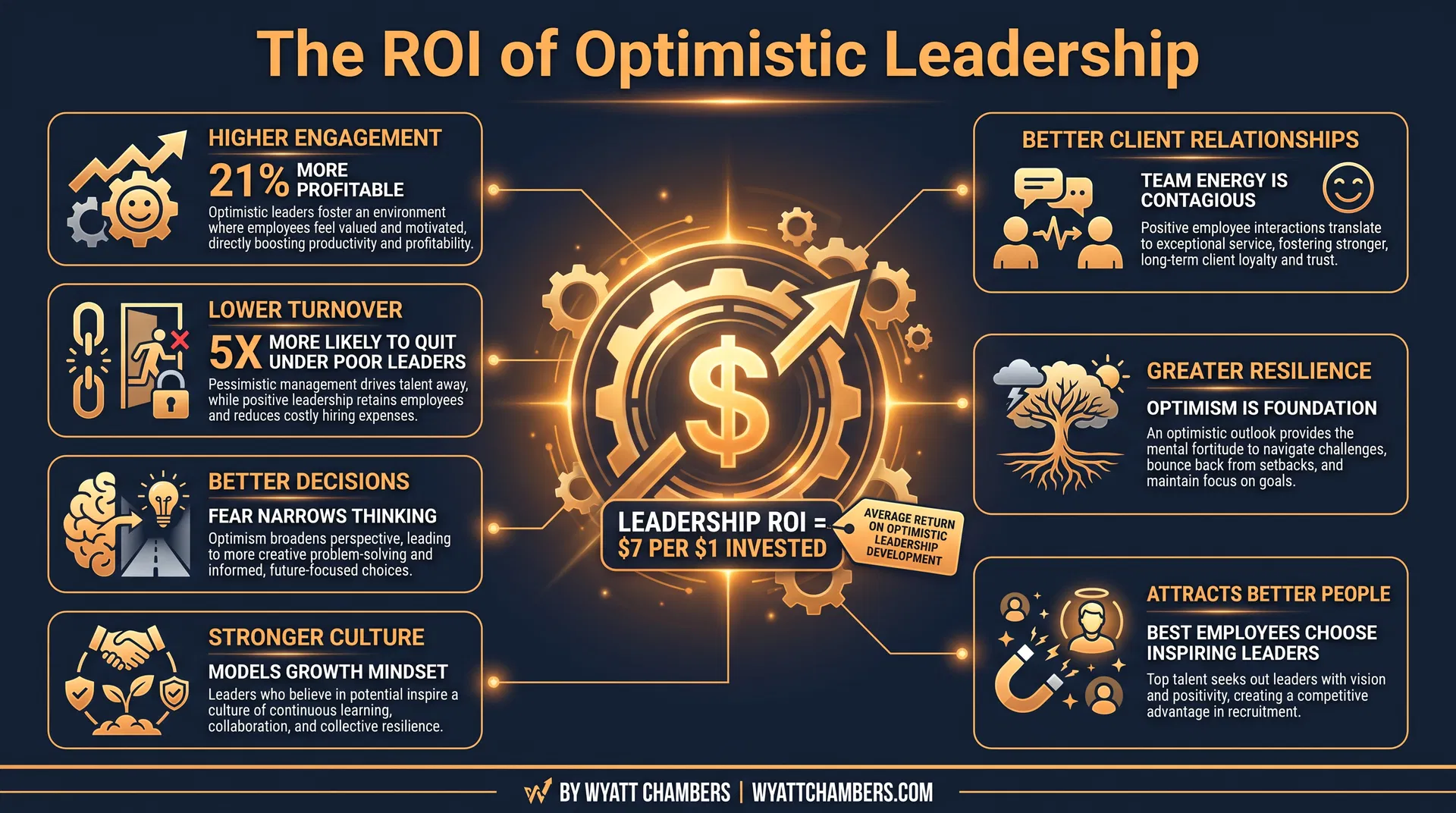
Key Stats: Leadership development returns $7 for every $1 spent | High engagement drives 21% higher profitability | Employees with poor managers are 5x more likely to quit | Leaders with high EQ drive 50% higher productivity | Organizations with inclusive leadership report 4.2x better financial performance
The Business Case for Optimism
Let me be direct: staying optimistic as a business owner is not about toxic positivity, ignoring problems, or pretending everything is fine when it is not.
It is about choosing a mindset that produces better outcomes — for your team, your clients, and your bottom line.
The data on this is clear and compelling. Leadership development returns $7 for every $1 spent. Optimistic leaders drive 21% higher profitability through employee engagement. Leaders with high emotional intelligence boost team productivity by 50%. Employees with poor managers — managers who are negative, reactive, and fear-driven — are 5 times more likely to quit.
Optimism is not soft. It is one of the highest-ROI investments a business owner can make.
What Optimistic Leadership Actually Looks Like
Optimistic leadership is not about pretending problems do not exist. It is about how you frame problems, how you respond to setbacks, and what you communicate to your team about the future.
The optimistic leader says: "This is a serious challenge. Here is what we know, here is what we are doing about it, and here is why I believe we will get through it."
The pessimistic leader says: "This is a serious challenge. I am not sure what we are going to do. This might be really bad."
Both leaders are dealing with the same problem. But the first leader is building a team that leans in. The second is building a team that starts updating their resumes.
The Seven Business Benefits of Optimistic Leadership
1. Higher Employee Engagement
Engaged employees are 21% more productive and 22% more profitable. And the single biggest driver of employee engagement is the quality of their relationship with their direct manager.
Optimistic leaders create the conditions for engagement by communicating a compelling vision, celebrating progress, and making employees feel that their work matters and that the future is worth working toward.
2. Lower Turnover
Employee turnover is one of the most expensive problems a business can have. The cost of replacing an employee ranges from 50% to 200% of their annual salary, depending on the role.
Poor leadership — specifically, negative, reactive, and fear-driven leadership — is the primary driver of voluntary turnover. When you invest in developing an optimistic leadership style, you are directly investing in retention.
3. Better Decision-Making Under Pressure
Optimistic leaders make better decisions under pressure because they are not operating from a place of fear. Fear narrows thinking, reduces creativity, and leads to reactive decisions that often make problems worse.
Optimism expands thinking, increases creativity, and enables the kind of deliberate, values-driven decision-making that produces good outcomes even in difficult circumstances.
4. Stronger Culture
Culture is not what you put on the wall. It is what you model every day as a leader. When you consistently demonstrate optimism, resilience, and a growth mindset, you are setting the cultural standard for your entire organization.
Teams that operate in a culture of optimism are more collaborative, more innovative, and more willing to take the calculated risks that drive growth.
5. Better Client Relationships
Clients can feel the energy of an organization. When they interact with a team that is engaged, confident, and optimistic, they feel more confident in their decision to work with you.
When they interact with a team that is anxious, disengaged, or negative, they start looking for alternatives.
6. Greater Resilience
Every business faces setbacks — economic downturns, lost clients, failed initiatives, unexpected challenges. The businesses that survive and thrive through these setbacks are led by people who maintain their optimism and their sense of possibility even when circumstances are difficult.
Resilience is not the absence of adversity. It is the ability to maintain forward momentum in the presence of adversity. And optimism is the foundation of resilience.
7. Attracting Better People
Optimistic leaders attract optimistic people. The best employees — the ones with options, the ones who could work anywhere — choose to work for leaders who inspire them, challenge them, and make them believe in a compelling future.
When you cultivate an optimistic leadership style, you become a magnet for the kind of talent that drives exceptional outcomes.
Practical Strategies for Cultivating Optimistic Leadership
Start with gratitude. A daily gratitude practice — even just three things you are grateful for each morning — rewires your brain toward positive pattern recognition. This is not woo-woo; it is neuroscience.
Separate facts from interpretations. When something goes wrong, practice distinguishing between what actually happened (the facts) and the story you are telling yourself about what it means (the interpretation). Facts are neutral. Interpretations are a choice.
Invest in your own development. The best investment you can make in your leadership is continuous learning. Read, attend events, join a peer advisory group, work with a coach. Growth creates optimism.
Celebrate small wins. Most leaders wait for the big wins to celebrate. Optimistic leaders celebrate progress — the small steps forward that add up to significant outcomes over time.
Manage your inputs. What you consume shapes how you think. Be intentional about the news, social media, and conversations you allow into your mental environment.
The Bottom Line
Optimism is not a personality trait you either have or do not have. It is a skill you develop through practice, and it is one of the highest-leverage investments you can make as a business leader.
The data is clear: optimistic leaders build more profitable businesses, retain better employees, and create organizations that are more resilient, innovative, and capable of sustained growth.
Stay curious. Stay positive. Stay in the game.