
Key Principle: What you tolerate, you teach. Every time you address disrespect promptly and directly, you reinforce the standard. Every time you let it slide, you erode it.
What You Tolerate, You Teach
There is a principle I have come back to repeatedly in 18+ years of building teams: what you tolerate, you teach.
When a leader allows disrespect to go unaddressed — the eye-roll in the meeting, the dismissive comment about a colleague, the passive-aggressive email — they are not just ignoring a behavior. They are setting the cultural standard.
They are teaching everyone in the organization that this behavior is acceptable. And that lesson is learned quickly and spread widely.
Disrespect in the workplace is not a minor interpersonal issue. It is a leadership issue. And it is one of the fastest ways to destroy the culture you have worked to build.
The Forms Disrespect Takes
Disrespect in the workplace is not always obvious. It rarely starts with shouting or explicit insults. It usually starts with subtler behaviors that, if left unaddressed, escalate over time.
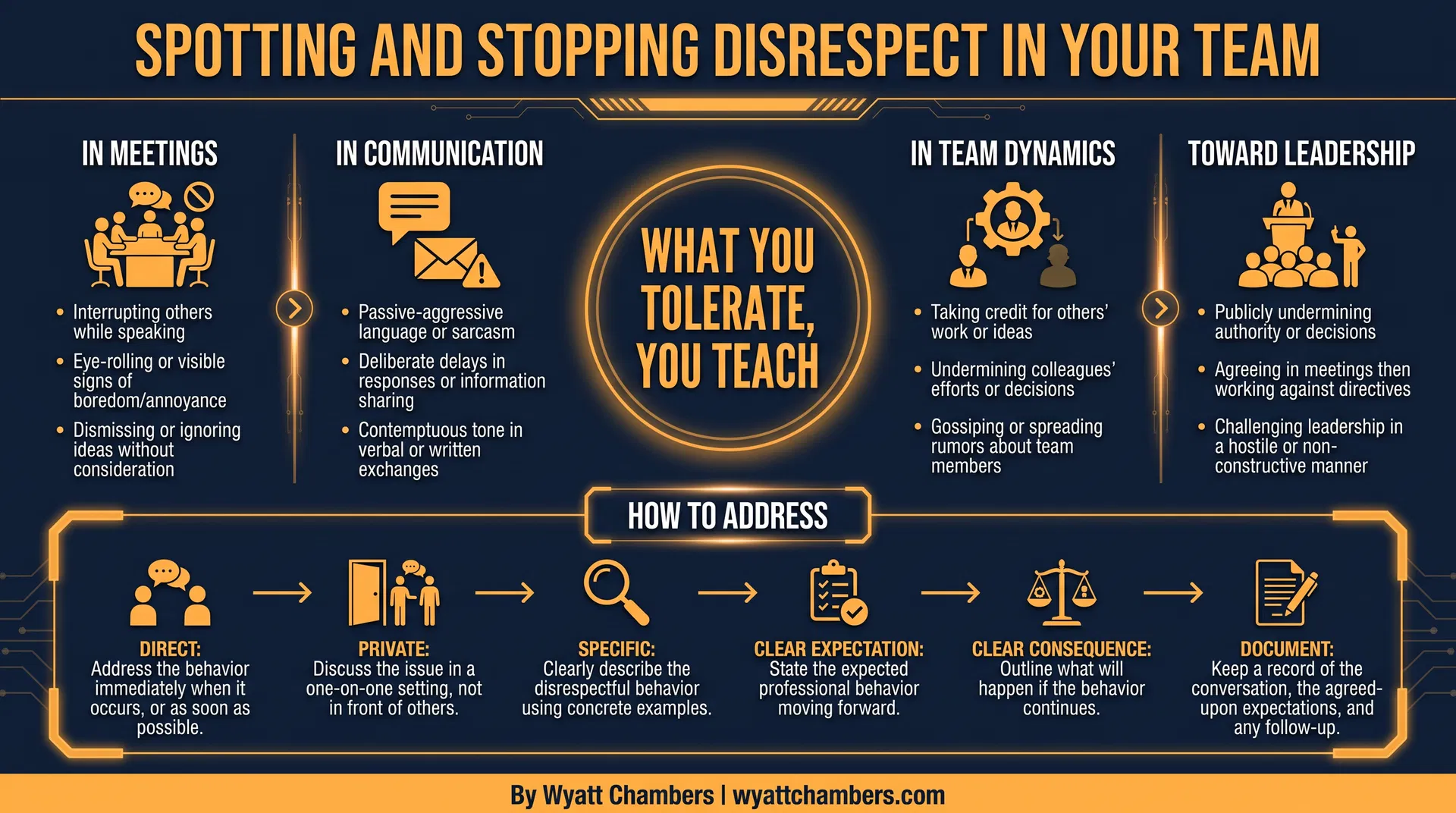
In meetings:
- Interrupting or talking over colleagues
- Eye-rolling, sighing, or checking phones while others are speaking
- Dismissing ideas without engagement ("That will never work")
- Dominating conversations and not creating space for others
In communication:
- Passive-aggressive language (sarcasm, backhanded compliments)
- Responding to messages with minimal effort or deliberate delay
- Copying people on emails to create pressure or embarrassment
- Tone that is technically professional but clearly contemptuous
In team dynamics:
- Taking credit for others' work
- Undermining colleagues in front of clients or leadership
- Gossiping or creating factions within the team
- Bypassing established processes to signal that rules do not apply to them
Toward leadership:
- Publicly questioning decisions in ways designed to undermine rather than improve
- Agreeing in meetings and then working against decisions outside of them
- Treating feedback as an attack rather than an opportunity
Why Your Best People Leave First
When disrespect is tolerated in a team, it does not affect everyone equally. The people who leave first are your best employees — the ones with the most options, the highest standards, and the least tolerance for a culture that does not align with their values.
The people who stay are the ones who either adopt the disrespectful behavior (because it is now the cultural norm) or become disengaged (because they have given up on the culture improving).
This is why tolerating disrespect is not just a culture problem — it is a talent retention problem, a performance problem, and ultimately a business problem.
How to Address Disrespect Directly
Address it immediately. Do not wait for a formal review or accumulate examples over time. Address disrespectful behavior as close to the moment it occurs as possible.
Address it privately. Public correction creates defensiveness and embarrassment. Private correction creates the conditions for honest conversation.
Be specific and behavioral. Use specific behavioral language rather than character judgments. "When you interrupted Sarah three times in the meeting today, it undermined her contribution and set a tone I am not willing to accept" is more effective than "You are disrespectful."
Be clear about the expectation. State clearly what behavior you expect going forward. Do not leave room for ambiguity.
Be clear about the consequence. If the behavior continues, what happens? Be honest about this. Vague warnings without consequences are not accountability — they are theater.
Document the conversation. Follow up in writing. This protects you legally and creates a record of the pattern if the behavior continues.
Building a Culture Where Respect Is Non-Negotiable
The most effective way to address disrespect is to build a culture where it is genuinely rare — where the norms, values, and expectations are so clear that disrespectful behavior stands out immediately and is addressed by the team, not just by leadership.
This starts with modeling. As a leader, how you treat people in every interaction sets the standard. If you are dismissive, impatient, or contemptuous — even occasionally — you are giving permission for others to be the same.
It continues with explicit values. Make respect a named, defined value in your organization. Not just a word on the wall, but a behavior that is discussed, modeled, recognized, and enforced.
And it requires consistent enforcement. Every time you address disrespect promptly and directly, you reinforce the standard. Every time you let it slide, you erode it.
The Bottom Line
The culture of your organization is built one interaction at a time. What you tolerate, you teach. What you model, you multiply.
Do not tolerate disrespect. Address it directly, consistently, and with the confidence of a leader who knows that a respectful culture is not just the right thing to build — it is the most productive thing to build.