
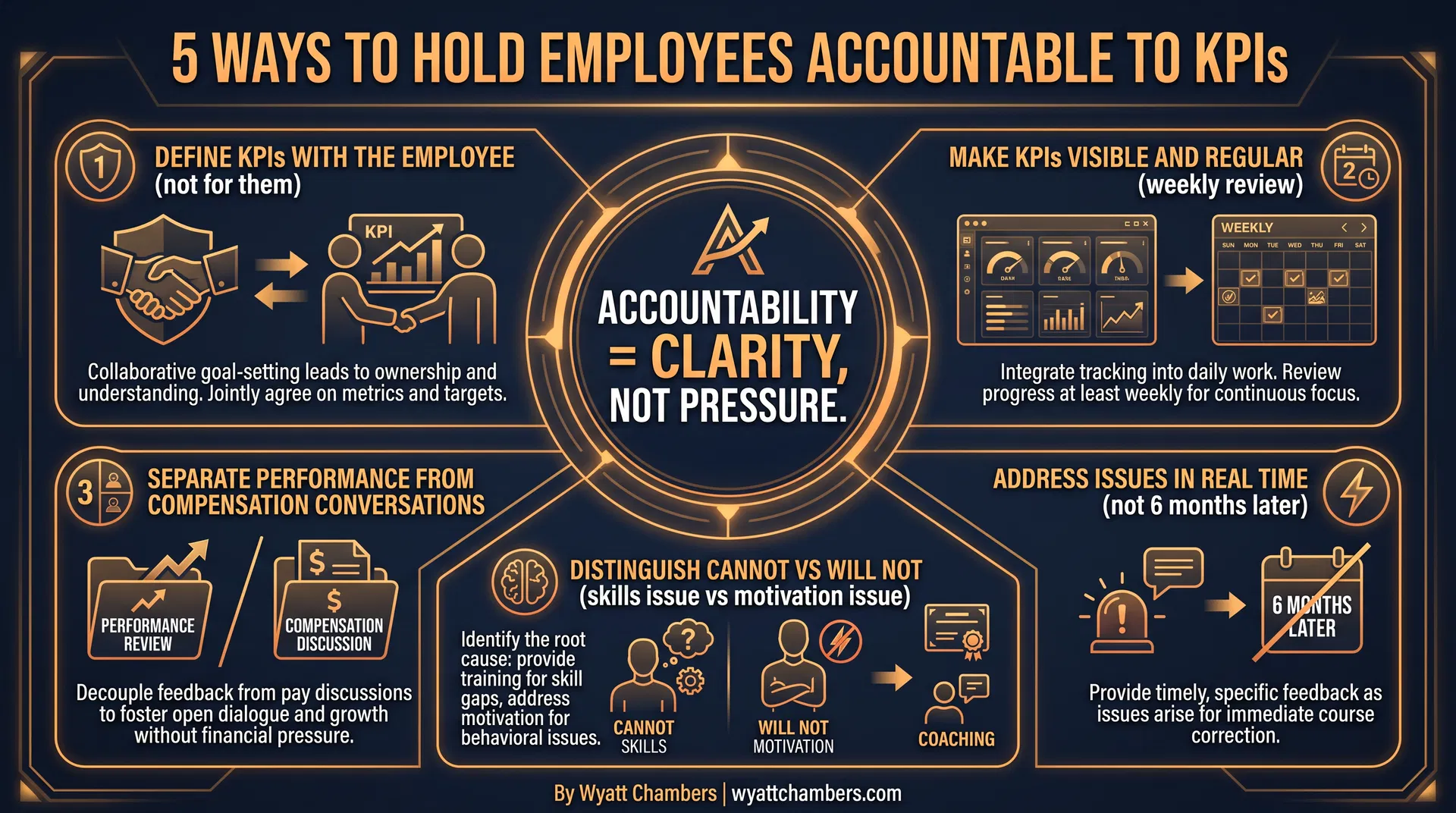
Key Insight: Accountability without clarity is just criticism. When people know exactly what is expected, why it matters, and how they will be measured — most of them rise to meet those expectations.
Accountability Is Not a Dirty Word
In my experience working with hundreds of business owners through CS Design Studios, SWARM, and the EOS framework, the word "accountability" makes a lot of people uncomfortable.
Leaders worry about being too harsh. Employees worry about being micromanaged. And so the result is often a culture where expectations are vague, performance conversations are avoided, and problems compound until they become crises.
Here is the truth: accountability is not about pressure. It is about clarity. The businesses with the highest-performing teams are not the ones with the most pressure — they are the ones with the clearest expectations.
When people know exactly what is expected of them, why it matters, and how their performance will be measured, most of them rise to meet those expectations. The accountability conversation becomes easy because everyone is working from the same set of facts.
Here are 5 strategies that actually work.
Strategy 1: Define KPIs With the Employee, Not For Them
The most common accountability failure is leaders defining KPIs in isolation and then presenting them to employees as a fait accompli. This creates resentment, reduces buy-in, and misses the opportunity to leverage the employee's own knowledge of what is achievable and what matters.
Instead, involve employees in the KPI-setting process. Ask them: "What metrics do you think best reflect the impact of your role? What do you think is a realistic but challenging target? What would need to be true for you to hit this number?"
When employees help define their own KPIs, they own them. And ownership drives performance.
Strategy 2: Make KPIs Visible and Regular
KPIs that are reviewed quarterly are not KPIs — they are annual review fodder. KPIs that drive performance are reviewed weekly, in a consistent forum, by the people responsible for them.
The EOS Scorecard is one of the most powerful tools I have implemented in my own businesses. It is a simple weekly review of the 5-15 most important metrics for the business, with clear owners and targets. Every week, in the Level 10 Meeting, we review the Scorecard. Red means off track. Green means on track. No ambiguity, no excuses, just data.
When KPIs are visible and reviewed regularly, they stop being a performance management tool and start being a navigation tool. The team uses them to course-correct in real time, not to assign blame after the fact.
Strategy 3: Separate Performance Conversations from Compensation Conversations
One of the biggest barriers to honest accountability conversations is the conflation of performance feedback with compensation decisions. When employees believe that every performance conversation is a potential threat to their pay, they become defensive rather than receptive.
Separate these conversations. Have regular, ongoing performance conversations that are focused entirely on growth, development, and problem-solving. Have compensation conversations separately, on a defined schedule.
This creates the psychological safety for honest performance conversations — which is the only kind of performance conversation that actually improves performance.
Strategy 4: Address Issues in Real Time
The worst accountability conversation is the one that happens six months after the problem started. By then, the employee has been doing the wrong thing for six months, the leader has been silently frustrated for six months, and the conversation is loaded with accumulated tension.
Address performance issues in real time. When you see a KPI trending in the wrong direction, have the conversation immediately. Not a formal review — a direct, caring, problem-solving conversation: "I noticed X is trending down. What is going on? What do you need to get back on track?"
Real-time feedback is more effective, less stressful, and more respectful than delayed accountability.
Strategy 5: Distinguish Between Will Not and Cannot
When a KPI is consistently missed, there are two possible explanations: the employee cannot perform at the required level (a skills or capacity issue) or the employee will not perform at the required level (a motivation or values issue).
These require completely different responses.
A "cannot" problem requires training, resources, coaching, or role redesign. A "will not" problem requires a direct values conversation, and if the values misalignment is fundamental, a transition out of the role.
The most common mistake leaders make is treating "will not" problems as "cannot" problems — investing in training and coaching for someone who is not committed to the role — and vice versa.
Get clear on which problem you are dealing with before you decide how to respond.
The Bottom Line
Accountability is a gift. When you hold your team accountable to clear, meaningful KPIs, you are telling them: "I believe you are capable of this, and I care enough about your success to be honest with you when you are off track."
That is not pressure. That is leadership.