
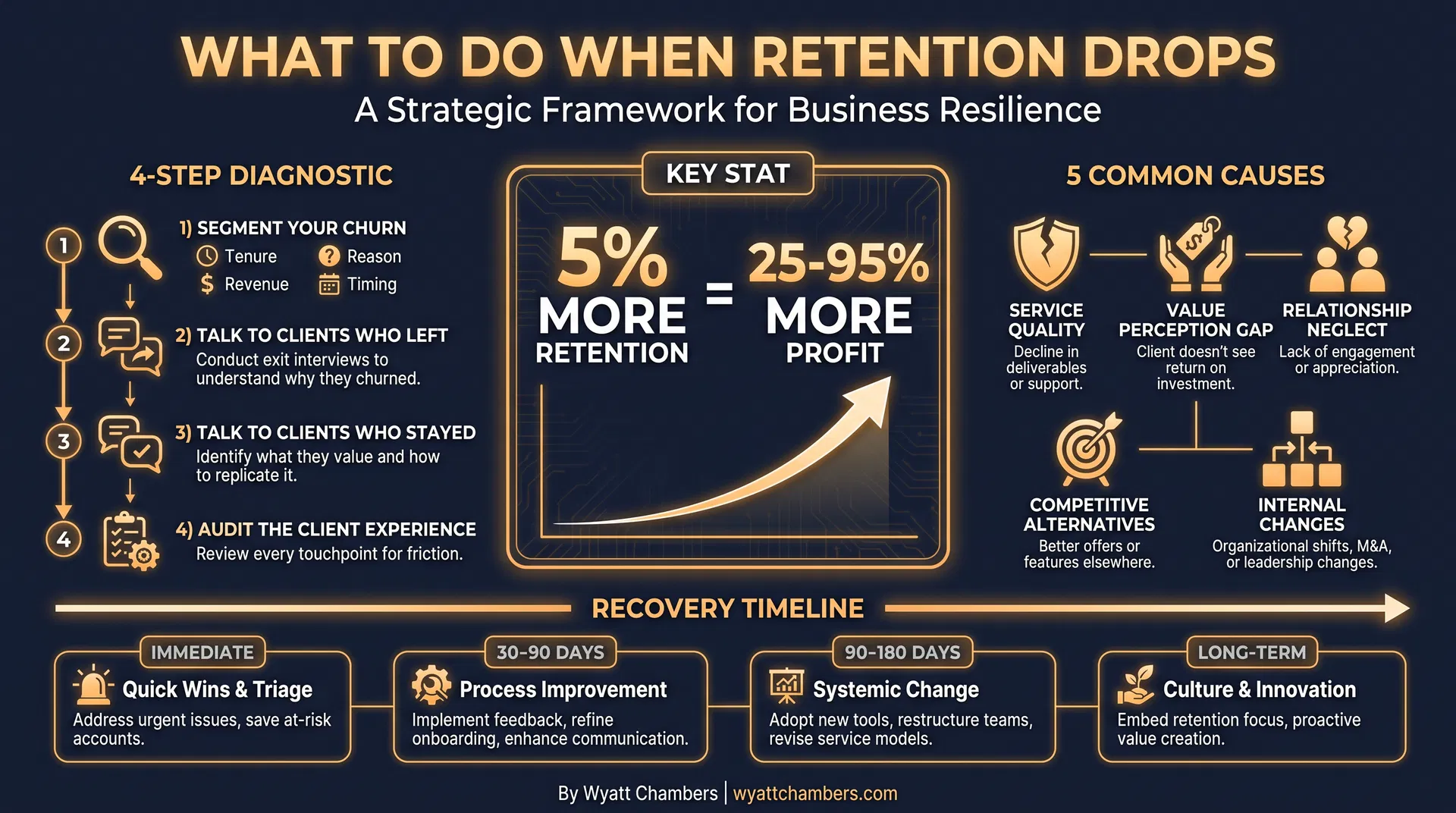
Key Stat: A 5% increase in customer retention can increase profits by 25-95%.
The Retention Warning Sign You Cannot Afford to Ignore
A 5% increase in customer retention can increase profits by 25-95%. That is not a typo. The compounding effect of keeping clients longer is one of the most powerful financial levers in any service business.
Which means that when retention rates start dropping, it is one of the most urgent signals a business owner can receive — and one that most business owners respond to too slowly.
The typical response is to look at the obvious symptoms: the clients who cancelled, the complaints that came in, the reviews that turned negative. These are important, but they are lagging indicators. By the time clients are cancelling, the problem has usually been building for months.
The businesses that reverse retention declines quickly are the ones that diagnose the root cause accurately and move fast. Here is the framework.
The Retention Diagnostic Framework
Step 1: Segment Your Churn
Not all churn is created equal. Before you can fix a retention problem, you need to understand who is leaving and why.
Segment your churned clients by:
- Tenure — Are you losing new clients, long-term clients, or both?
- Revenue — Are you losing high-value clients, low-value clients, or both?
- Reason — What reasons are they giving for leaving?
- Timing — When in the client lifecycle are they leaving?
This segmentation will often reveal patterns that point directly to the root cause.
Step 2: Talk to the Clients Who Left
This is the step most business owners skip, and it is the most important one.
Call the clients who cancelled. Not to win them back (yet), but to genuinely understand what happened. Ask open-ended questions. Listen without defensiveness. Thank them for their honesty.
You will learn more from five honest exit conversations than from months of internal analysis.
Step 3: Talk to the Clients Who Stayed
Just as important as understanding why clients leave is understanding why clients stay. Talk to your most loyal, longest-tenured clients. Ask them what keeps them coming back. Ask them what you do that they value most.
This often reveals the specific elements of your service that are most worth protecting and investing in.
Step 4: Audit the Client Experience
Map the entire client journey from onboarding through ongoing service delivery. At each touchpoint, ask:
- Is this experience consistent?
- Is this experience meeting or exceeding expectations?
- Is there a gap between what we promise and what we deliver?
Most retention problems trace back to a specific point in the client journey where the experience breaks down.
The Five Most Common Causes of Retention Decline
1. Service quality inconsistency. The most common cause of churn is inconsistent service delivery. Clients can tolerate occasional problems; they cannot tolerate unpredictability.
2. Value perception gap. Clients stop seeing the value in what they are paying for. This often happens not because the value has decreased, but because it has not been communicated effectively.
3. Relationship neglect. Clients feel forgotten. No proactive outreach, no check-ins, no sense that anyone cares whether they stay or go.
4. Competitive alternatives. A better option has emerged. This is often the stated reason for churn, but it is rarely the real reason. Clients who feel genuinely valued rarely leave for a competitor, even if the competitor is cheaper.
5. Internal changes. A key contact changed, pricing increased, or scope was reduced without adequate communication or relationship management.
The Retention Recovery Plan
Once you have diagnosed the root cause, the recovery plan follows a clear sequence:
Immediate: Address the most urgent service quality issues. If clients are leaving because of a specific problem, fix that problem first.
Short-term (30-90 days): Implement a proactive outreach program for at-risk clients. Personal calls from senior leaders, not automated emails.
Medium-term (90-180 days): Redesign the client experience at the specific touchpoints where the breakdown is occurring.
Long-term: Build retention metrics into your regular business review process so you catch declines early.
The Bottom Line
Retention is not a customer service problem. It is a leadership problem. The business owners who maintain high retention rates are the ones who treat client relationships as a strategic priority — who invest in understanding what clients value, who communicate proactively, and who respond quickly when something goes wrong.
A 5% improvement in retention can change your business. Start with the diagnostic, and move fast.