
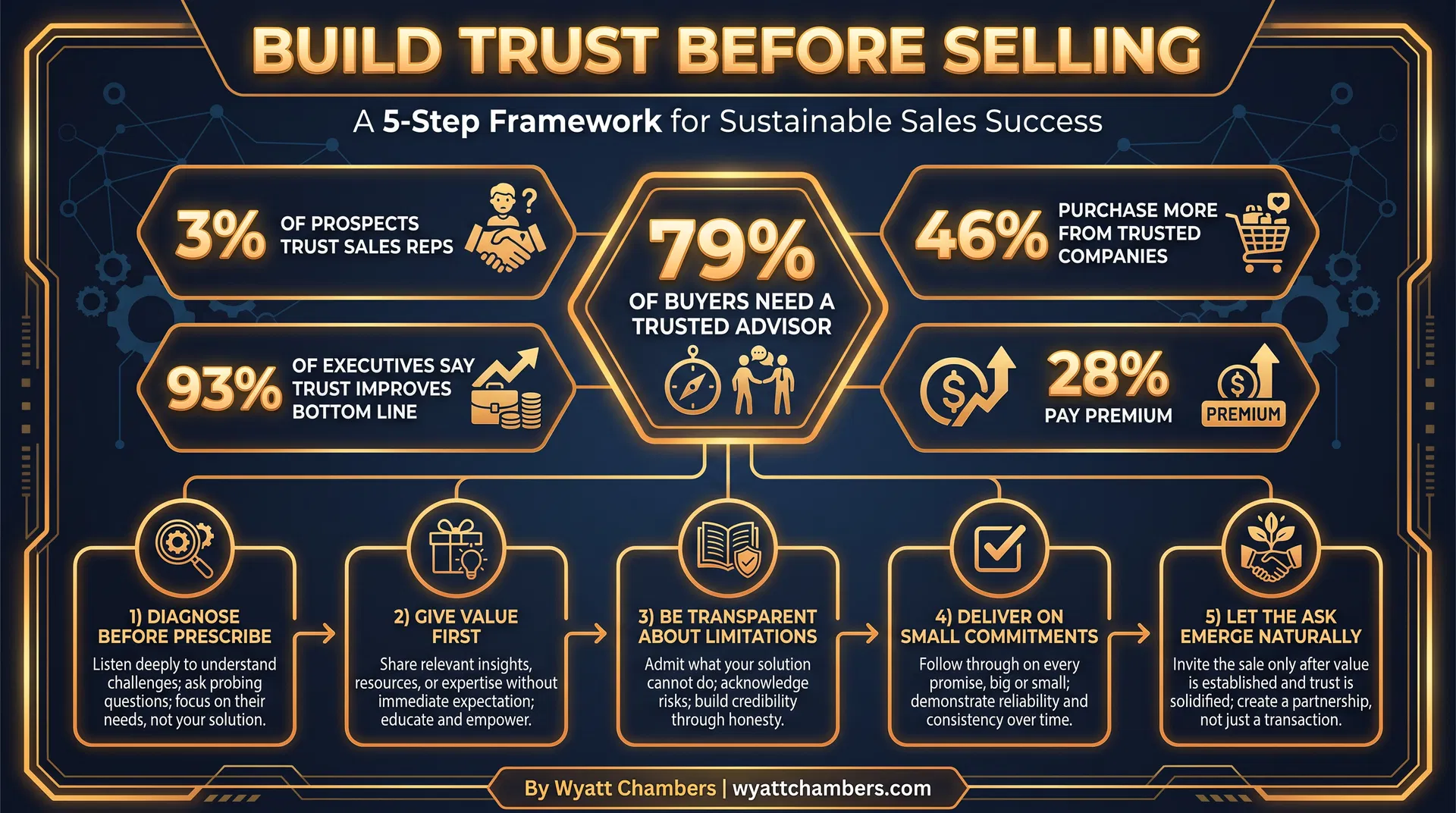
Key Stats: Only 3% of prospects trust sales reps | 93% of executives say trust improves the bottom line (PwC) | 79% of buyers say it is critical to interact with a trusted advisor | 46% purchase more from companies they trust | 28% pay a premium from companies they trust
The Trust Gap in Modern Business
Here is a statistic that should stop every business owner in their tracks: only 3% of prospects trust sales reps.
Three percent. That means when you reach out to a potential client, 97 out of 100 of them start from a position of skepticism or outright distrust. No matter how good your product is, no matter how compelling your pitch, you are starting in a hole.
The business owners who understand this — and build their entire client acquisition strategy around closing the trust gap before making an ask — consistently outperform those who lead with the pitch.
After 18+ years building CS Design Studios and SWARM Pest Control Marketing, the single most consistent pattern I have observed in successful client relationships is this: the best clients come from relationships where I gave value long before I asked for anything.
The Data on Trust and Revenue
The numbers are unambiguous:
- 93% of business executives agree that building and maintaining trust improves the bottom line (PwC)
- 79% of business buyers say it is critical to interact with a trusted advisor (Salesforce)
- 46% of consumers purchased more from companies they trust (PwC)
- 28% of consumers paid a premium from companies they trust (PwC)
- 90% of executives think customers highly trust them, but only 30% of consumers actually do (PwC)
That last statistic is the most important one. There is a massive perception gap between how much trust business owners think they have earned and how much trust their clients actually feel. Closing that gap is the entire game.
The Value-First Framework
Step 1: Diagnose Before You Prescribe
The most common mistake in client acquisition is leading with your solution before you understand the prospect's problem. This signals that you care more about selling than about helping.
The value-first approach starts with genuine curiosity. Ask questions. Listen carefully. Understand the specific challenges, goals, and constraints of the person in front of you before you say a single word about what you offer.
This alone differentiates you from 90% of your competitors, because most salespeople are too eager to pitch to actually listen.
Step 2: Give Something Valuable Without Strings
Before you ask for a meeting, a proposal, or a sale, give something genuinely useful. This could be:
- A relevant article or resource that addresses their specific challenge
- An introduction to someone who can help them
- A candid assessment of their current situation
- A piece of advice that serves their interests, even if it doesn't serve yours
The key word is "genuinely." People can tell the difference between a value-add that is designed to create obligation and one that is offered with no strings attached. Only the latter builds real trust.
Step 3: Be Transparent About Your Limitations
One of the most powerful trust-building moves a business owner can make is to be honest about what you cannot do or what you are not the right fit for.
When you tell a prospect "I don't think we are the right fit for your situation, but here is who I would recommend" — you build more trust in that moment than most salespeople build in months of follow-up. You have demonstrated that your advice can be trusted, because you are willing to give it even when it costs you a sale.
Step 4: Deliver Consistently on Small Commitments
Trust is built in the small moments. When you say you will send something by Tuesday and it arrives Monday, you make a deposit. When you follow up when you said you would, you make a deposit. When you remember something from a previous conversation and reference it, you make a deposit.
These small deposits compound over time into a trust account that makes the eventual ask feel natural rather than presumptuous.
Step 5: Let the Ask Emerge Naturally
When you have done the first four steps well, you rarely have to ask for the business directly. The prospect asks you. They say "how do we get started?" or "what would it look like to work together?" because you have already demonstrated value and built the trust that makes the decision easy.
This is the goal: not to close the sale, but to create the conditions where the prospect closes themselves.
The Long-Term Compounding Effect
The value-first approach is not just a sales strategy. It is a business philosophy that compounds over time.
Every client you acquire through genuine trust and value delivery becomes a source of referrals, testimonials, and long-term loyalty. Every client you acquire through pressure or manipulation becomes a source of churn, complaints, and negative word-of-mouth.
The math is simple: the best clients come from the best relationships, and the best relationships are built on trust and value.
The Bottom Line
In a world where only 3% of prospects trust sales reps, the business owners who lead with value and build trust before asking for anything have an enormous competitive advantage. They spend less on marketing, close at higher rates, retain clients longer, and generate more referrals.
The value-first approach is not the slow path to revenue. It is the fast path to sustainable revenue.