
The Operating System Your Business Has Been Missing
I have been an entrepreneur for 18 years. I have built agencies, co-founded pest control companies, served as a Fractional CMO for dozens of businesses, and run a mastermind for hundreds of operators. And I can tell you with confidence that the single most impactful thing I have done for my businesses in the last several years is implementing EOS.
Not a new marketing strategy. Not a new technology platform. A business operating system.
EOS — the Entrepreneurial Operating System — is the framework developed by Gino Wickman and described in his book Traction. It is used by over 200,000 companies worldwide, and it works because it addresses the fundamental challenges that hold most entrepreneurial businesses back: lack of clarity, lack of accountability, and lack of traction.
The 6 Key Components of EOS
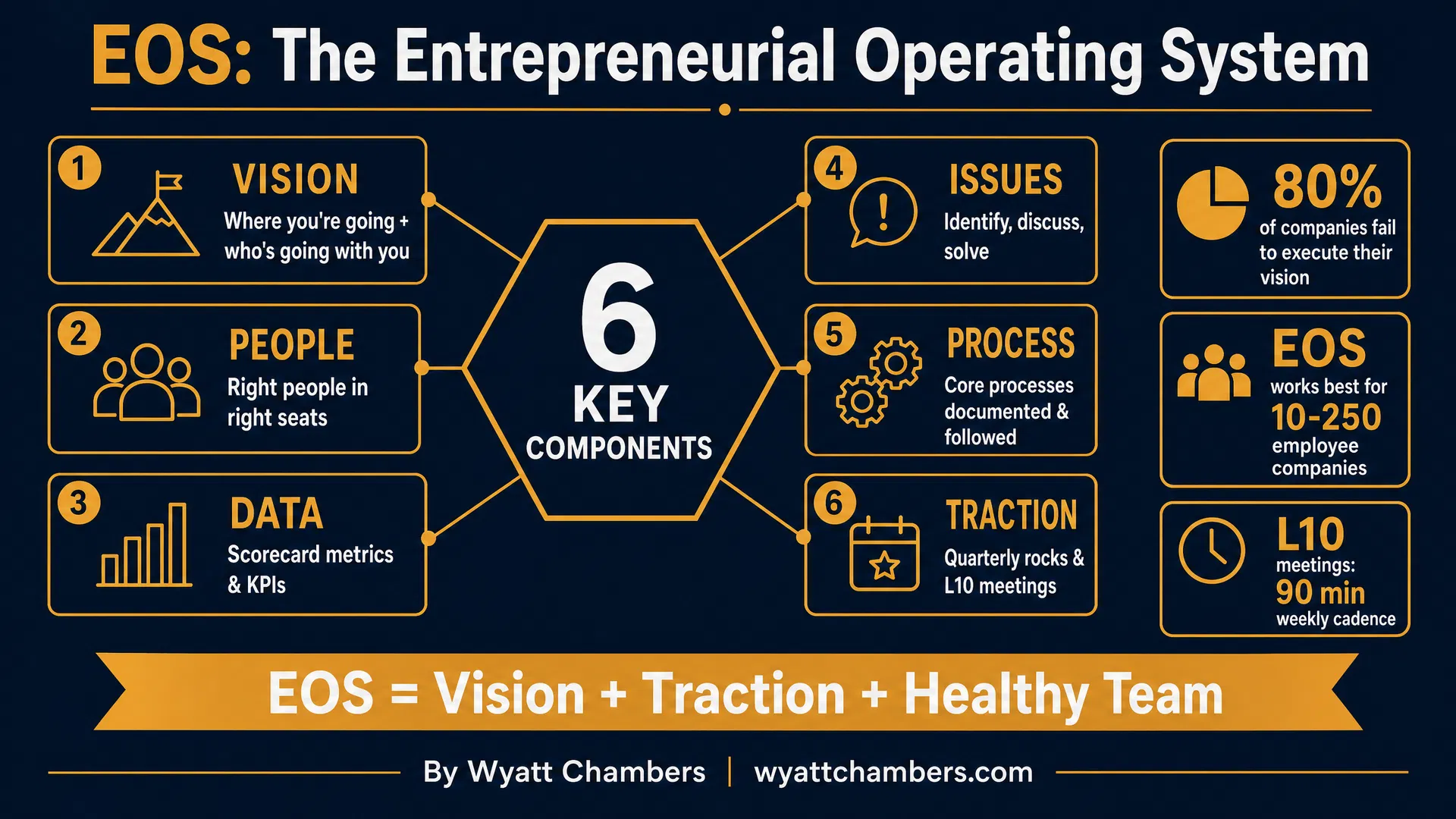
EOS by the Numbers:
- 80% of companies fail to execute their vision — EOS directly solves this
- Best fit: Companies with 10–250 employees
- L10 meetings: 90-minute weekly cadence that replaces unproductive meetings
- EOS formula: Vision + Traction + Healthy Team = Organizational Excellence
What EOS Actually Is
EOS is not a management philosophy or a motivational framework. It is a practical set of tools that help you run your business more effectively. It is built around six core components, which EOS calls the Six Key Components of any business.
Vision — Does everyone in your organization know where you are going and how you are going to get there? EOS uses a tool called the V/TO (Vision/Traction Organizer) to capture your 10-year target, 3-year picture, 1-year plan, and 90-day priorities on a single page.
People — Do you have the right people in the right seats? EOS uses the People Analyzer to evaluate team members against your core values and the GWC (Gets it, Wants it, Capacity to do it) framework.
Data — Are you running your business on facts or feelings? EOS uses a Scorecard — a weekly dashboard of 5-15 measurable numbers — to give you an objective pulse on your business every week.
Issues — Every business has issues. The question is whether you are solving them or just talking about them. EOS uses the IDS process (Identify, Discuss, Solve) to ensure that issues get resolved, not just discussed.
Process — Are your core processes documented and followed by everyone? EOS helps you identify, document, and systematize your key processes so the business can run without depending on any single person.
Traction — Are you executing on your vision? EOS uses Rocks (90-day priorities) and the L10 meeting rhythm to create accountability and momentum.
The L10 Meeting: The Heartbeat of EOS
The Level 10 meeting is the tool I recommend most often to business owners who are just starting to explore EOS. It is a weekly 90-minute leadership team meeting with a specific, non-negotiable agenda.
The agenda covers: check-in, scorecard review, rock review (are your 90-day priorities on track?), customer and employee headlines, to-do review, and IDS — where the team identifies, discusses, and solves the most important issues facing the business that week.
The L10 meeting replaces the unfocused, meandering meetings that waste hours of leadership time every week with a structured, productive session that actually moves the business forward. Most leadership teams that implement L10 meetings report that they are the most productive meetings they have ever run.
Why EOS Works Especially Well for Smaller Businesses
Large corporations have entire departments dedicated to strategy, operations, HR, and finance. They have the infrastructure to manage complexity. Smaller businesses — typically 10 to 250 employees — do not. They are trying to do everything with limited resources, and the result is often chaos disguised as hustle.
EOS gives smaller businesses the structure of a large organization without the bureaucracy. The tools are simple enough to implement without a dedicated operations team, but powerful enough to create genuine organizational clarity and accountability.
The businesses I have seen benefit most from EOS are those in the 10-50 employee range — large enough that the founder can no longer manage everything personally, but small enough that they have not yet built formal systems. EOS fills that gap.
Getting Started with EOS
The best starting point is Gino Wickman's book Traction, which is available everywhere books are sold. It walks through the entire EOS framework in practical, accessible terms.
If you want to accelerate implementation, working with a certified EOS Implementer is the fastest path. As an EOS Practitioner myself, I have seen firsthand how much faster companies progress when they have an experienced guide helping them through the process.
The V/TO, the Scorecard, and the L10 meeting are the three tools I recommend implementing first. Start there, run them consistently for 90 days, and you will understand why over 200,000 companies have built their businesses on EOS.