
The Books That Changed How I Lead
I have been building businesses for 18 years. In that time, I have made every mistake in the book — and learned from most of them. But some of my most important lessons did not come from failure. They came from books that gave me a framework for thinking about leadership, delegation, systems, and growth that I simply did not have before.
These are the 10 books I recommend most often to the CEOs and business owners I work with. They are not ranked by quality — they are all excellent. They are sequenced roughly by the order in which I think most entrepreneurs will find them most useful.
The Essential Leadership Reading List
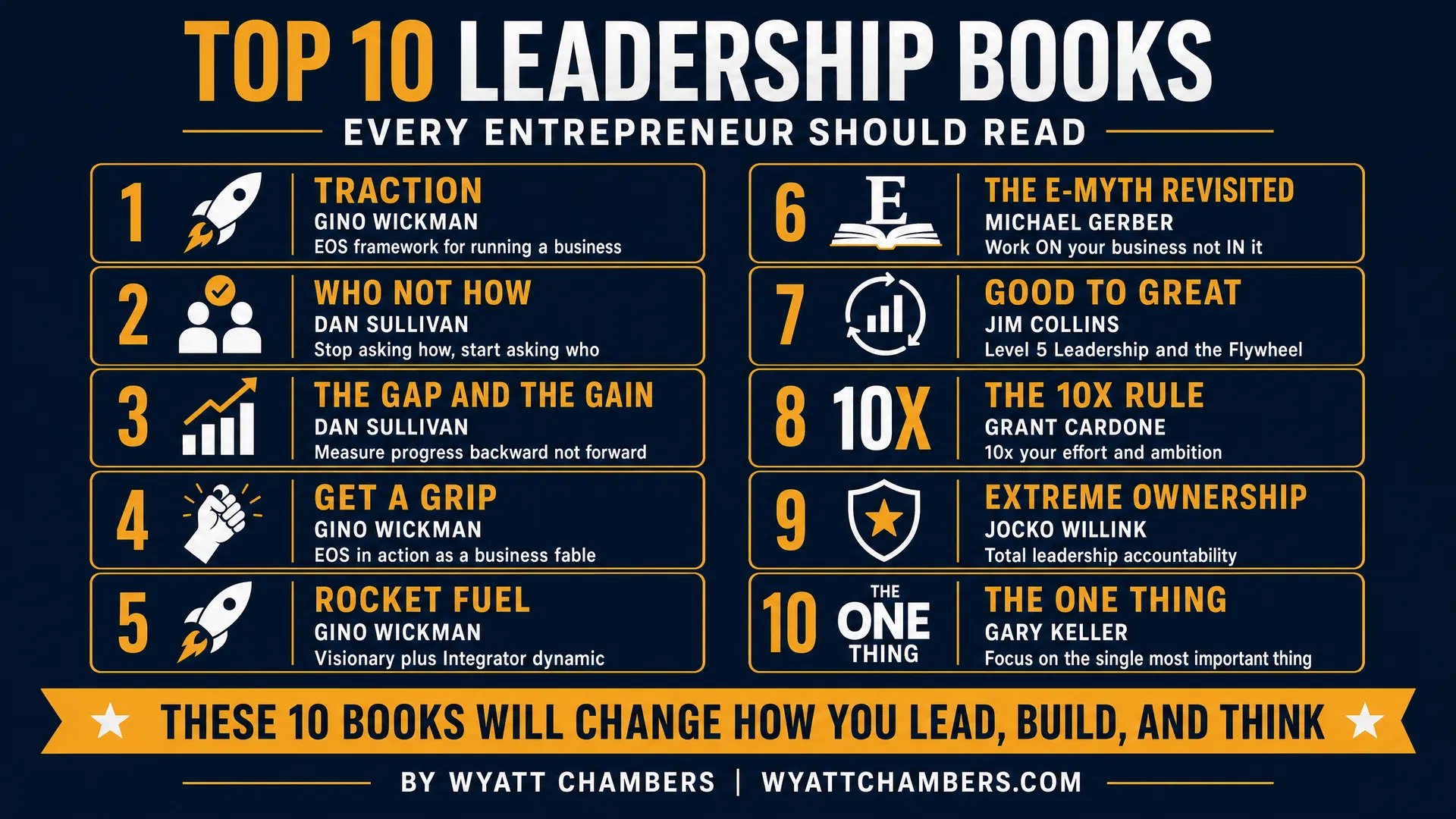
The 10 Books at a Glance:
- Traction — Gino Wickman — The EOS framework every 10-250 employee business needs
- Who Not How — Dan Sullivan — Stop asking how, start asking who
- The Gap and The Gain — Dan Sullivan — Measure progress backward, not against an ideal
- Get a Grip — Gino Wickman — EOS in action as a relatable business fable
- Rocket Fuel — Gino Wickman — The Visionary + Integrator dynamic that scales companies
- The E-Myth Revisited — Michael Gerber — Work ON your business, not IN it
- Good to Great — Jim Collins — Level 5 Leadership and the Flywheel concept
- The 10X Rule — Grant Cardone — Multiply your effort and ambition by 10
- Extreme Ownership — Jocko Willink — Total leadership accountability, no excuses
- The ONE Thing — Gary Keller — The Focusing Question that eliminates distraction
1. Traction by Gino Wickman
If you run a business with 10 or more employees and you have not read Traction, stop what you are doing and order it today. Wickman's Entrepreneurial Operating System (EOS) is the most practical, comprehensive framework for running a small to midsize business that I have ever encountered. It covers vision, people, data, issues, process, and traction — the six components that every healthy business needs to master.
I am an EOS Practitioner, and I have seen this book transform businesses that were stuck in chaos into organizations with clarity, accountability, and momentum. The L10 meeting alone is worth the price of the book.
2. Who Not How by Dan Sullivan and Dr. Benjamin Hardy
This book will fundamentally change how you think about your time and your role as a leader. The core insight is deceptively simple: stop asking "How do I do this?" and start asking "Who can do this for me?" Every time you try to figure out how to do something yourself, you are choosing to be a bottleneck instead of a multiplier.
Sullivan's framework for identifying the right "Whos" — people whose unique abilities complement your own — is one of the most practical delegation frameworks I have encountered.
3. The Gap and the Gain by Dan Sullivan and Dr. Benjamin Hardy
This is the book I recommend most often to entrepreneurs who are high-achieving but chronically dissatisfied. Sullivan's insight is that most successful people measure themselves against an ideal (the Gap) rather than against where they started (the Gain). The result is a perpetual sense of falling short, regardless of how much they have accomplished.
The Gain mindset — measuring progress backward from where you are to where you started — is transformative for both personal wellbeing and leadership effectiveness.
4. Get a Grip by Gino Wickman and Mike Paton
If Traction is the EOS textbook, Get a Grip is the EOS novel. It tells the story of a fictional company implementing EOS, which makes the concepts tangible and relatable in a way that a framework book cannot. Read this after Traction to see the system in action.
5. Rocket Fuel by Gino Wickman and Mark C. Winters
One of the most important decisions any entrepreneur makes is whether they are a Visionary or an Integrator — and whether they have the right counterpart. Rocket Fuel explores the Visionary/Integrator dynamic in depth, explaining why most businesses need both and how to find, hire, and work with the right partner.
This book helped me understand my own strengths and limitations as a leader in a way that nothing else had.
6. The E-Myth Revisited by Michael E. Gerber
Gerber's classic is still essential reading for any entrepreneur who finds themselves working in their business rather than on it. The distinction between the Entrepreneur, the Manager, and the Technician — and the trap of letting the Technician dominate — is as relevant today as when it was written.
7. Good to Great by Jim Collins
Collins and his research team spent five years studying companies that made the leap from good to great performance and sustained it. The findings — Level 5 Leadership, the Hedgehog Concept, the Flywheel — are among the most rigorously researched insights in business literature.
8. The 10X Rule by Grant Cardone
Cardone's core thesis is that most people underestimate the effort required to achieve their goals by a factor of 10. The 10X Rule is not subtle, but it is effective at breaking the mental ceiling that limits most entrepreneurs' ambition and action.
9. Extreme Ownership by Jocko Willink and Leif Babin
Two former Navy SEAL commanders apply the leadership principles they learned in combat to business. The central thesis — that leaders must take complete ownership of everything in their domain, with no excuses — is uncomfortable and transformative in equal measure.
10. The ONE Thing by Gary Keller and Jay Papasan
In a world of infinite distraction and competing priorities, Keller's framework for identifying and focusing on the single most important thing is essential. The Focusing Question — "What is the ONE Thing I can do such that by doing it everything else will be easier or unnecessary?" — is one of the most powerful productivity tools I use regularly.
Building Your Reading Practice
Reading these books is only valuable if you apply what you learn. I recommend reading one book per month, taking notes on the key insights, and identifying one specific change you will make in your business as a result. Share what you are reading with your leadership team — the best leadership books are most powerful when they create a shared vocabulary and framework across your organization.