The Search Engine You Grew Up With Is Gone
If you built your digital marketing strategy around Google organic search and have not revisited it in the last 12 months, you are operating with a dangerously outdated map. Google Search in 2026 looks and behaves fundamentally differently from the platform that drove business growth for the past two decades.
The change is not subtle. AI Overviews — the AI-generated summaries that appear at the top of search results — have caused 20-40% traffic declines for informational content across the industry. Google's new AI Mode is replacing the traditional blue-link results page with a conversational AI interface. Zero-click searches, where users get their answer directly from Google without visiting any website, have become the majority of searches for many query types.
This is not a temporary disruption. It is a structural transformation of how people find information online. Businesses that adapt will maintain and grow their search visibility. Those that do not will watch their organic traffic decline year over year.
The Big Changes in Google Search 2026
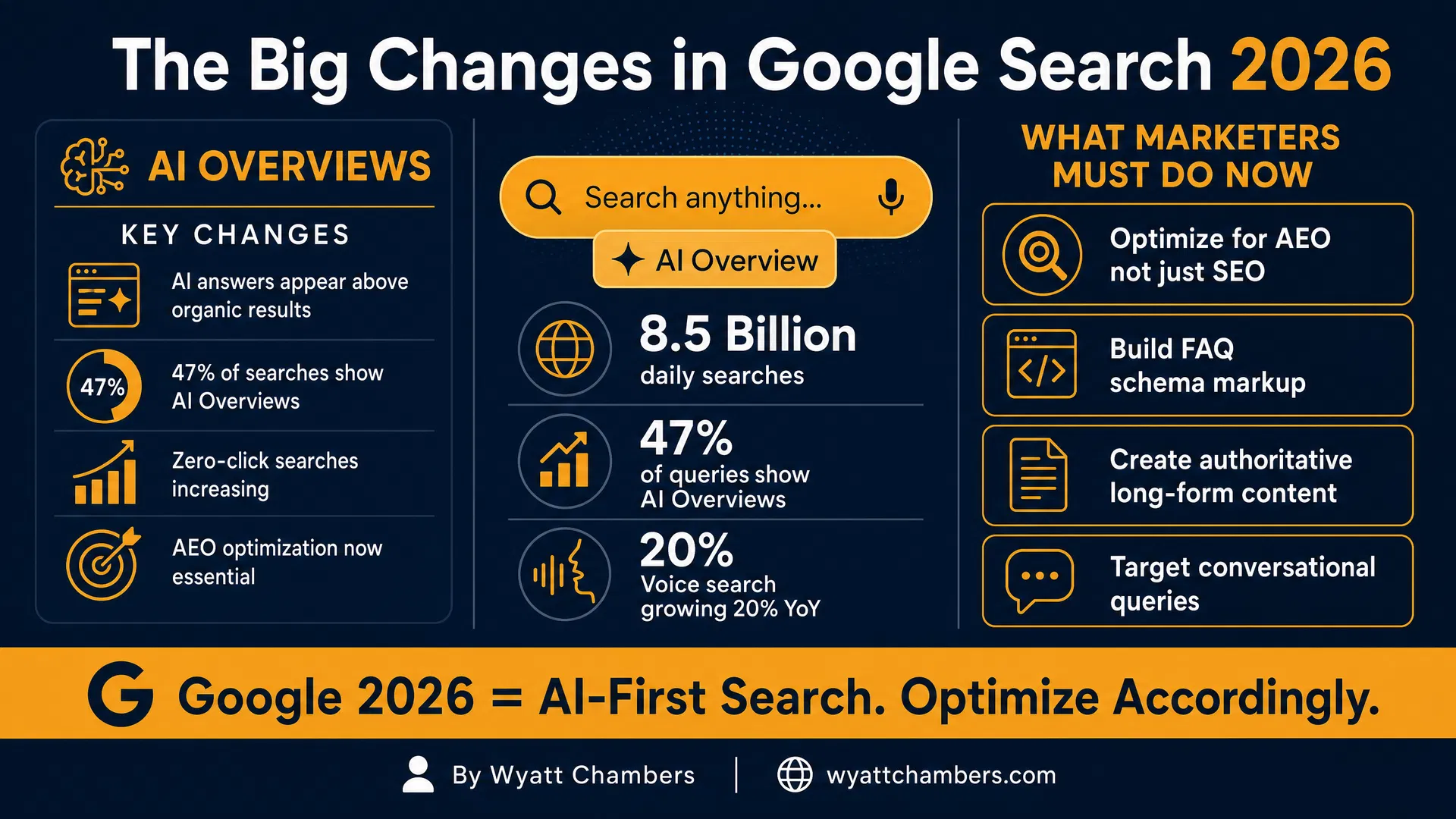
Google Search 2026 Key Stats:
- 8.5 billion daily searches — still the world's largest search engine
- 47% of searches now show AI Overviews above organic results
- 20-40% traffic decline for informational content due to AI Overviews
- Voice search growing 20% year-over-year
- Zero-click searches are now the majority for many query types
- AEO (Answer Engine Optimization) is now as important as traditional SEO
What Actually Changed: A Plain-English Breakdown
AI Overviews appear at the top of search results for a wide range of queries and synthesize information from multiple sources into a single answer. The user gets what they need without clicking. For businesses that relied on informational content to drive top-of-funnel traffic, this is the most significant change.
AI Mode takes this further by replacing the entire search results page with a conversational AI experience. Users can ask follow-up questions, refine their search, and get synthesized answers — all without leaving Google. This is Google's most aggressive move toward becoming an answer engine rather than a search engine.
Faster answers, fewer clicks. The combination of AI Overviews, featured snippets, knowledge panels, and AI Mode means that a growing percentage of searches end on Google's results page. For businesses that depend on organic click-through, this is a direct revenue impact.
What Still Works: The Opportunities in the New Landscape
The changes are significant, but they create opportunities as well as challenges.
Transactional searches are largely unaffected. When someone searches "pest control near me" or "HVAC repair Tucson," they want a service provider — not an AI-generated answer. Local service searches, product searches, and transactional queries still drive click-through behavior. Businesses with strong local SEO and Google Business Profile optimization are less exposed to the AI Overview disruption.
Brand searches are growing in importance. As AI Overviews capture more informational traffic, branded searches — people searching specifically for your company name — become more valuable. Investing in brand awareness through other channels (OOH, social, podcast, referrals) drives branded search volume that is immune to AI Overview disruption.
Being cited in AI Overviews is a new opportunity. Google's AI Overviews cite sources, and being cited drives both direct traffic and brand authority. The way to get cited is to have the most authoritative, well-structured content on a topic — which means investing in genuine topical expertise rather than keyword-stuffed content.
The Adaptation Playbook for 2026
Restructure your content for AI extraction. Every page on your website should have a clear, concise answer to the primary question it addresses. Use FAQ sections with structured question-and-answer formatting. Implement FAQ schema markup. Write in clear, direct language that AI systems can extract and cite.
Build topical authority, not just keyword rankings. Google's AI systems favor sources that comprehensively cover a topic area. Instead of targeting isolated keywords, build content clusters that cover every aspect of your core topics. This is how you become the authoritative source that AI Overviews cite.
Double down on local SEO. Google Business Profile optimization, local citations, and review generation are more important than ever. Local transactional searches are the segment of Google traffic least affected by AI Overviews.
Diversify your traffic sources. If you are heavily dependent on Google organic traffic, 2026 is the year to invest in email list building, social media presence, and direct traffic channels. The businesses that will be most resilient are those that do not depend on any single traffic source.
The businesses that will dominate search in 2026 and beyond are the ones that understand the new rules and adapt their strategy accordingly. The old playbook — publish content, rank for keywords, drive traffic — still works in some contexts. But it needs to be supplemented with a new playbook built for the AI era.