
The Search Landscape Has Fundamentally Changed
If you built your digital marketing strategy around traditional SEO five years ago and have not revisited it since, you are operating with an outdated map. The search landscape has changed more in the last two years than in the previous decade, and the businesses that understand the new terrain will have a significant advantage.
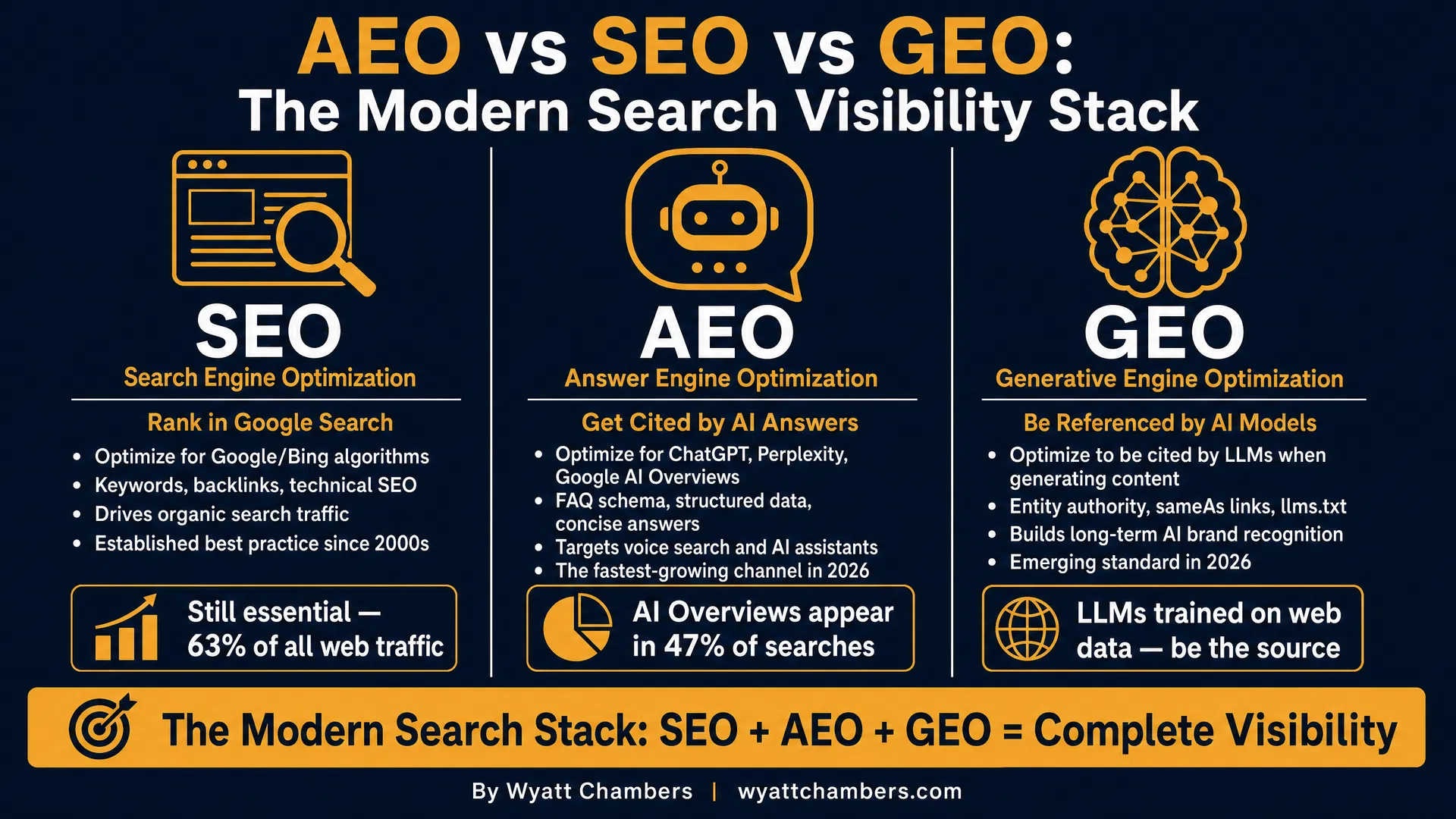
Three acronyms define modern search visibility: SEO, AEO, and GEO. They are not competing strategies — they are three layers of the same stack. Here is what each one means and why all three matter.
The Modern Search Visibility Stack
Quick Reference: The Three Layers Compared
| | SEO | AEO | GEO | |---|---|---|---| | Full name | Search Engine Optimization | Answer Engine Optimization | Generative Engine Optimization | | Goal | Rank in Google/Bing | Get cited by AI answers | Be referenced by LLMs | | Targets | Google, Bing algorithms | ChatGPT, Perplexity, AI Overviews | LLM training data, citations | | Key tactics | Keywords, backlinks, technical SEO | FAQ schema, concise answers, structured data | Entity authority, sameAs links, llms.txt | | Stat | 63% of all web traffic | AI Overviews in 47% of searches | LLMs trained on web data | | Priority | Foundation — do this first | Fastest-growing in 2026 | Longest-term play |
SEO: The Foundation That Still Matters
Search Engine Optimization is the practice of optimizing your website and content to rank higher in Google's organic search results. It encompasses technical optimization (site speed, mobile-friendliness, structured data), on-page optimization (keyword targeting, content quality, internal linking), and off-page optimization (backlinks, brand mentions, local citations).
SEO is not dead. Google still processes over 8.5 billion searches per day, and organic search remains the highest-volume, highest-intent traffic source for most businesses. But SEO alone is no longer sufficient, because the way people interact with search results is changing rapidly.
AEO: Optimizing for the Answer, Not Just the Ranking
Answer Engine Optimization is the practice of structuring your content so that AI-powered answer engines can extract and present it as a direct answer to a user's question.
This matters because Google's AI Overviews, ChatGPT, Perplexity, and voice assistants are increasingly answering questions directly — without the user ever clicking through to a website. If your content is not structured to be extracted as an answer, you are invisible in these results even if you rank #1 organically.
AEO best practices include writing clear, concise answers to specific questions (ideally 40-60 words), using FAQ sections with structured question-and-answer formatting, implementing FAQ schema markup so Google can identify your Q&A content, and building topical authority by comprehensively covering a subject area rather than targeting isolated keywords.
GEO: Getting Cited by AI Models
Generative Engine Optimization is the newest of the three disciplines, and it is the one most marketers have not yet heard of. GEO is the practice of optimizing your content to be cited, summarized, or referenced by large language models when they generate responses.
When someone asks ChatGPT "what is the best pest control marketing strategy," the model draws on the content it was trained on and the sources it can access. GEO is about making sure your content is the kind of authoritative, well-structured, frequently-cited material that AI models are likely to reference.
GEO best practices include building genuine topical authority (not just keyword density), earning citations and mentions from other authoritative sources, using clear attribution and author credentials, structuring content with explicit definitions and explanations, and keeping content current and accurate.
How They Work Together
Think of SEO, AEO, and GEO as three concentric circles of search visibility.
SEO gets you found in traditional search results. AEO gets your content extracted as a direct answer in AI-powered search features. GEO gets your brand and expertise cited by AI models when they answer questions in your domain.
A business that excels at all three has maximum visibility across every search touchpoint — traditional results, AI Overviews, voice search, and generative AI responses.
The Practical Takeaway
For most local service businesses, the priority order is: SEO first (it is the foundation), AEO second (it is the fastest-growing opportunity), and GEO third (it is the longest-term play but increasingly important).
Start by auditing your existing content for AEO opportunities: add FAQ sections to your service pages, implement FAQ schema markup, and make sure every page has a clear, concise answer to the primary question it is trying to answer. Then build from there.
The businesses that will dominate search in 2026 and beyond are the ones building for all three layers simultaneously.