The Biggest Shift in Facebook Advertising Since iOS 14
If you have been running Facebook Ads for any length of time, you know that the platform has been in a state of constant change since Apple's iOS 14 privacy update in 2021. But the changes that happened in early 2026 represent a more fundamental shift in how Meta wants advertisers to think about targeting.
In January 2026, Meta removed key detailed interest-based targeting options and made Advantage Detailed Targeting on by default for conversion and link click campaigns — meaning advertisers can no longer turn it off for those objectives. Combined with the aggressive push toward Advantage+ campaign types, Meta is clearly signaling that the era of manually defined, granular audience targeting is over.
This is not necessarily bad news for advertisers who understand what it means. But it requires a significant mindset shift.
Facebook Ads Targeting: What Changed in 2026
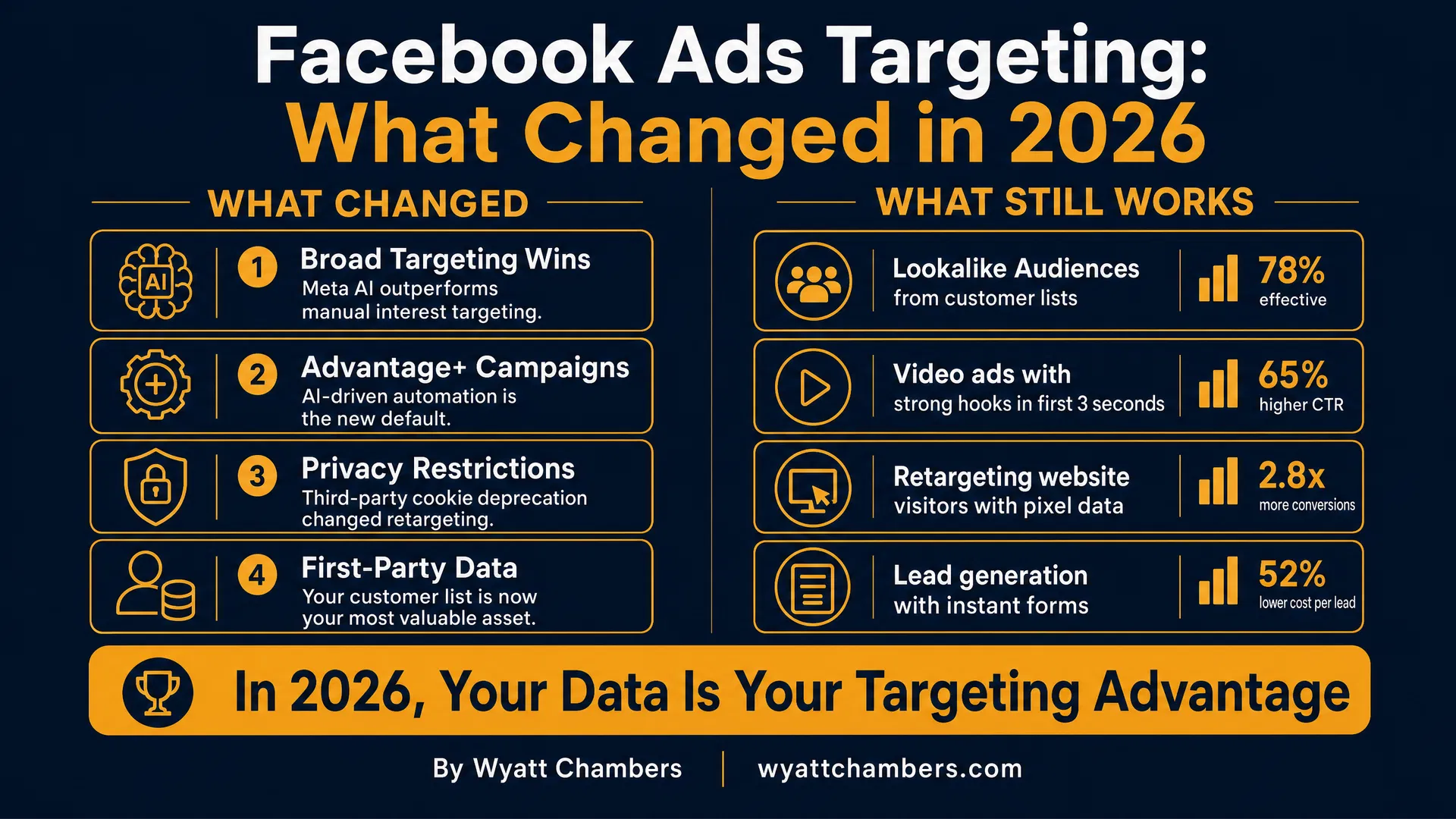
Facebook Ads 2026 Key Changes:
- Broad Targeting Wins — Meta's AI now outperforms manual interest targeting
- Advantage+ Campaigns — AI-driven automation is the new default for all campaign types
- First-Party Data — your customer list is now your most valuable targeting asset
- Video hooks — 65% higher CTR with strong first-3-second hooks
- Lookalike Audiences — still 78% effective when built from your best customers
- Lead gen with instant forms — 52% lower cost per lead vs. landing pages
From Audience-First to Creative-First
The old Facebook Ads playbook was audience-first: find the right targeting, then show them your ad. The new playbook is creative-first: make the best possible creative, then let Meta's AI find the right audience.
This shift is backed by data. Meta's own research, and independent studies by agencies and advertisers, consistently show that Advantage+ campaigns — where Meta's AI controls audience selection — outperform manually targeted campaigns when the creative is strong. The AI has access to behavioral signals that no human targeting setup can replicate.
What this means practically is that your competitive advantage in Facebook Ads no longer comes primarily from audience knowledge. It comes from creative quality, creative volume, and creative testing velocity.
What Advantage+ Actually Means for Your Campaigns
Advantage+ Shopping campaigns (ASC) were the first major Advantage+ product, and they have become the default recommendation for e-commerce advertisers. The format is simple: you provide your creative assets, set your budget and ROAS target, and Meta's AI handles everything else — audience selection, placement, creative rotation, and budget allocation.
For service businesses like pest control, HVAC, and home services, Advantage+ Audience campaigns work similarly. You can provide audience suggestions (people similar to your existing customers, people who have visited your website), but Meta's AI is free to expand beyond those suggestions if it finds better performance elsewhere.
The practical implication: stop spending time building elaborate custom audiences and lookalikes. Spend that time on creative instead.
The Creative Strategy That Wins in 2026
With targeting largely automated, creative is the primary lever. Here is what the data shows works in 2026:
Video dominates. Short-form video (15-30 seconds) consistently outperforms static images across all objectives. The first 3 seconds are critical — if you do not stop the scroll immediately, you lose the viewer.
User-generated content (UGC) style performs. Ads that look like organic content — filmed on a phone, authentic, conversational — outperform polished production in most categories. This is counterintuitive but consistent.
Multiple creative variants are essential. Running 3-5 creative variants per ad set allows Meta's AI to identify the best performer and allocate budget accordingly. Single-creative campaigns leave significant performance on the table.
Hooks are everything. The opening line of your video or the headline of your image ad determines whether someone stops scrolling. Test multiple hooks aggressively.
The New Targeting Toolkit
While granular interest targeting has been reduced, effective targeting options still exist:
Custom Audiences — your existing customer list, website visitors, and video viewers — remain highly effective and are not affected by the changes. These are your highest-intent audiences.
Lookalike Audiences built from your best customers continue to work well, though Meta's AI increasingly handles this automatically.
Broad targeting — running campaigns with minimal audience restrictions and letting Meta's AI optimize — is now the recommended approach for most advertisers, especially when you have strong creative.
The Bottom Line
Facebook Ads in 2026 rewards advertisers who invest in creative quality and testing velocity, and punishes those who rely on targeting precision as their primary advantage. The platform has become more of a creative media channel and less of a precision targeting tool.
For businesses with strong creative capabilities and a willingness to test, this is actually a better environment than the old one. The playing field is more level — you do not need a sophisticated audience research capability to compete. You need great creative and the discipline to test it systematically.