A New Advertising Frontier Just Opened
On February 9, 2026, OpenAI announced it was testing ads in ChatGPT. On May 5, 2026, it opened the ChatGPT Ads Manager to U.S. advertisers with CPA bidding. This is one of the most significant developments in digital advertising since Google launched AdWords in 2000.
The question for business owners and marketers is not whether ChatGPT advertising is interesting — it clearly is. The question is whether it makes sense for your business to be an early adopter right now, and what that looks like in practice.
Here is my honest assessment.
Does It Make Sense to Advertise on ChatGPT?
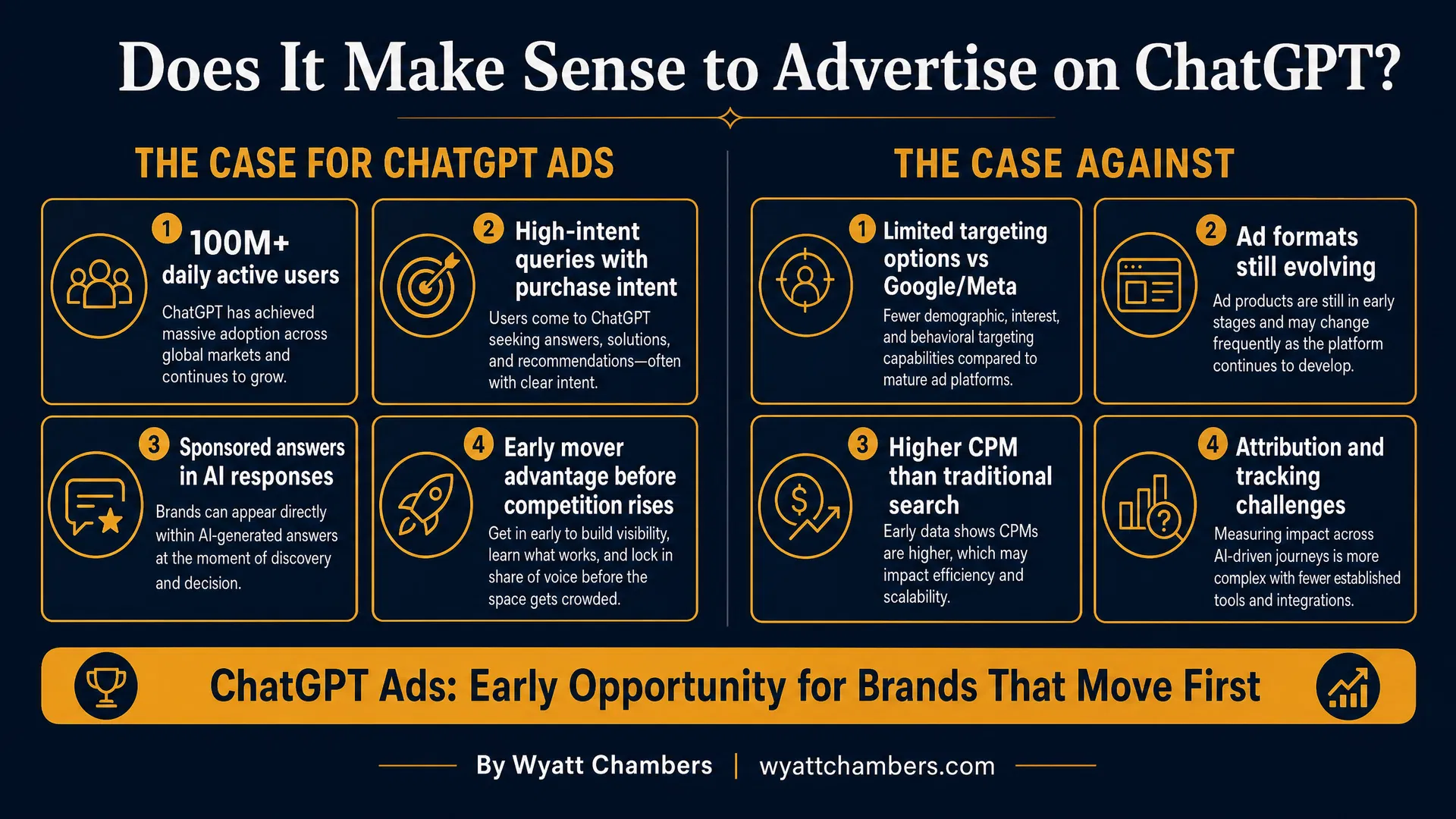
ChatGPT Ads: The Honest Assessment:
- 500 million weekly active users as of 2026
- $1B → $30B projected ad revenue growth from 2026 to 2030 (Truist)
- High-intent users — asking for recommendations and comparing options
- Contextual targeting — ads match the conversation topic, not demographics
- Early mover advantage — lower competition and costs now vs. 2028
- Honest caveat: Attribution, targeting, and brand safety still maturing
The Scale of the Opportunity
ChatGPT has over 500 million weekly active users as of 2026. It is the fastest-growing consumer technology product in history. And unlike Google, where users are searching for something specific, ChatGPT users are often in a discovery and decision-making mode — asking for recommendations, comparing options, and seeking guidance.
Truist estimates OpenAI will generate under $1 billion in ad revenue in 2026, growing to over $30 billion by 2030. That growth trajectory implies that the platform is still in its early stages — which historically means lower competition, lower costs, and higher returns for early adopters.
How ChatGPT Ads Actually Work
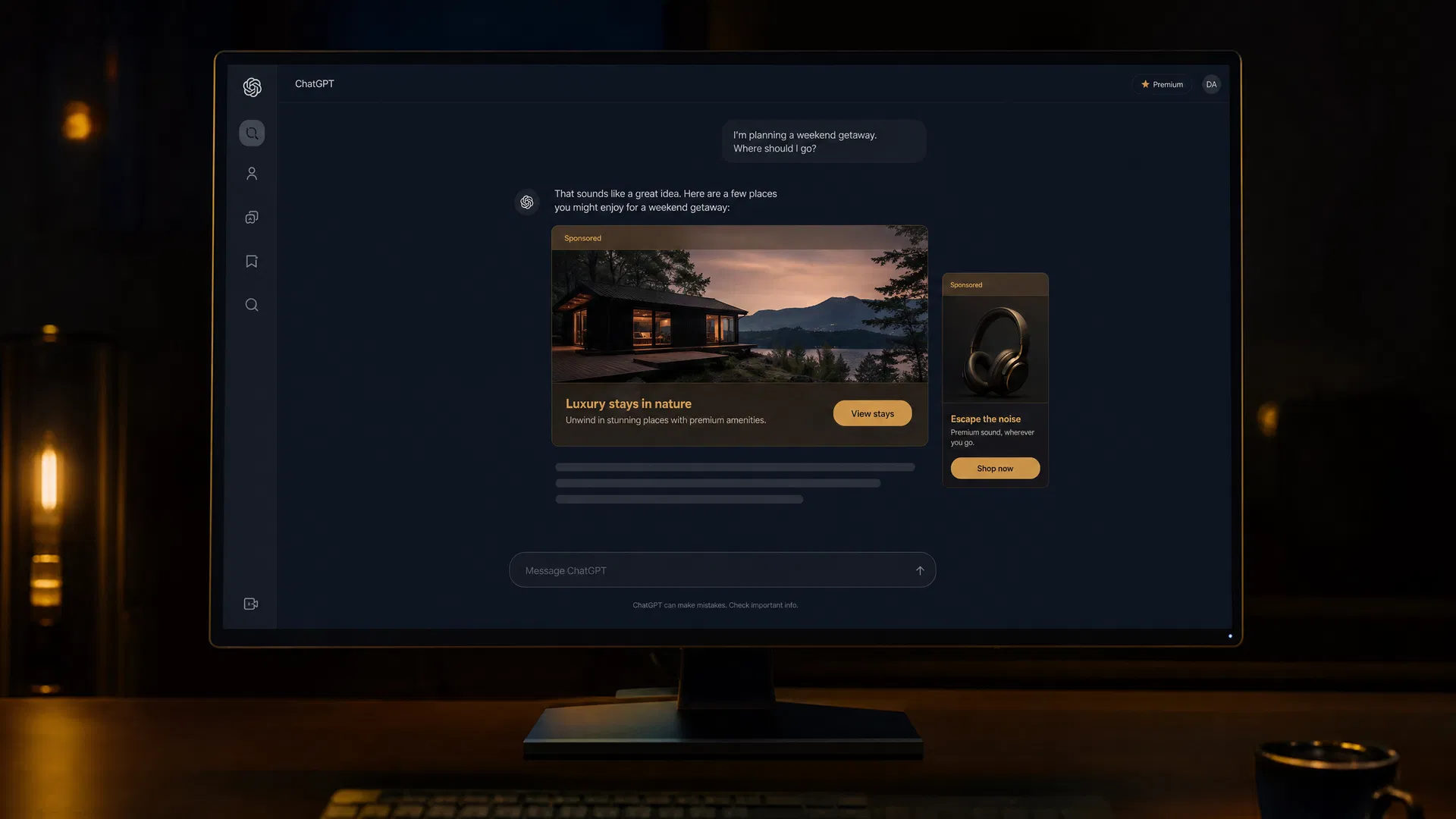
ChatGPT ads appear as sponsored content within the conversation interface, contextually relevant to the user's query. They are clearly labeled as sponsored. OpenAI has been explicit that advertisers have no ability to shape, rank, or alter ChatGPT's responses — ads are separate from the model's outputs.
The ad formats currently available include sponsored cards that appear alongside ChatGPT's responses, similar to how Google Shopping ads appear alongside search results. The targeting is based on the context of the conversation — what the user is asking about — rather than traditional demographic or interest-based targeting.
This contextual targeting model is potentially more powerful than traditional targeting for high-intent queries. A user asking ChatGPT "What is the best pest control company in Tucson?" is expressing extremely high purchase intent. An ad appearing in that context is reaching a prospect at the exact moment of decision.
The Case for Early Adoption
The history of digital advertising platforms consistently rewards early adopters. The businesses that advertised on Google in 2001, Facebook in 2008, and Instagram in 2013 built significant competitive advantages before those platforms became crowded and expensive.
ChatGPT advertising is at a similar inflection point. The platform has massive scale, high-intent users, and relatively low advertiser competition. The cost per click and cost per acquisition are likely to be significantly lower now than they will be in two or three years as more advertisers enter the platform.
For businesses in categories where ChatGPT users frequently ask for recommendations — home services, professional services, software, consumer products — the opportunity to appear in those conversations is genuinely valuable.
The Honest Caveats
ChatGPT advertising is new, and new advertising platforms always have rough edges. The measurement and attribution capabilities are less mature than Google Ads or Meta Ads. The ad formats are still evolving. And the user experience implications of ads in an AI conversation are not yet fully understood.
There is also a brand safety consideration. ChatGPT's responses are not controlled by advertisers, which means your ad could appear alongside responses that are not aligned with your brand. OpenAI has committed to brand safety controls, but the mechanisms are still being developed.
My Recommendation
For businesses with the budget and appetite for experimentation, ChatGPT advertising is worth testing now. The potential upside of early adoption is significant, and the cost of a small test campaign is modest.
For businesses that are budget-constrained or risk-averse, waiting 6-12 months for the platform to mature and for more performance data to emerge is a reasonable approach. The opportunity will still be there, and you will have better information to make decisions.
Either way, you should be paying attention. ChatGPT advertising is not a niche experiment — it is the beginning of a new advertising channel that will be significant within three years.
Visit ads.openai.com to learn more about the ChatGPT Ads platform and explore whether it makes sense for your business.