
Why Token Management Matters More Than You Think
If you use Claude regularly — especially Claude Code or Claude for complex research and writing tasks — you have probably hit the context window limit at an inconvenient moment. The conversation gets too long, Claude loses track of earlier context, or you run out of tokens before completing a complex task.
Token management is not just about cost (though for heavy users, it absolutely affects cost). It is about maintaining the quality and coherence of Claude's outputs across long, complex tasks. A well-managed context window means Claude has the right information available when it needs it, rather than being overwhelmed by irrelevant history.
Here are the most effective strategies for conserving token usage without sacrificing output quality.
Top Ways to Conserve Token Usage on Claude
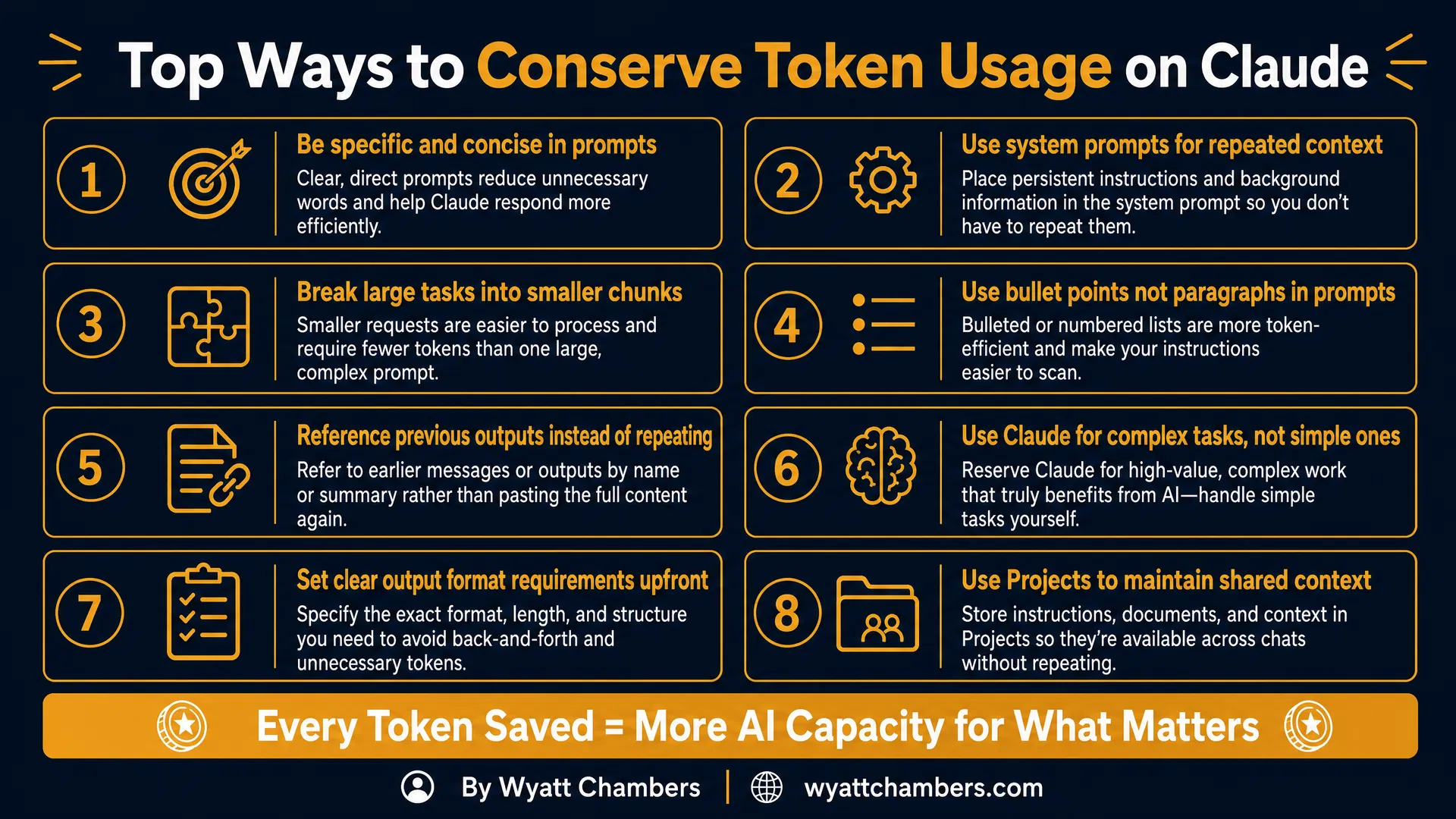
8 Token Conservation Strategies:
- Be specific and concise — every unnecessary word wastes tokens
- Use system prompts — store repeated context once, not in every message
- Break large tasks into chunks — smaller requests need fewer tokens
- Use bullet points — more token-efficient than paragraphs in prompts
- Reference previous outputs — don't repeat content, refer to it
- Reserve Claude for complex tasks — don't use AI for simple lookups
- Set output format upfront — avoid back-and-forth corrections
- Use Projects — shared context across chats without repeating
1. Start New Conversations for New Tasks
The single most effective token conservation strategy is also the simplest: start a new conversation for each distinct task. Carrying conversation history from a previous task into a new one consumes tokens on context that is no longer relevant.
This is counterintuitive for users who think of their Claude conversation as a persistent workspace. But Claude does not need to "remember" previous conversations to be effective — it needs the right context for the current task. Start fresh, provide the relevant context, and you will get better results with fewer tokens.
2. Use /compact in Long Sessions
In Claude Code and other extended sessions, the /compact command summarizes the conversation history into a compressed format. This preserves the essential context — what has been decided, what code has been written, what the current state of the project is — while dramatically reducing the token count.
Use /compact proactively before your context window fills up, not reactively after you hit the limit. A good rule of thumb is to compact every 30-50 messages in a long coding or research session.
3. Be Specific and Concise in Your Prompts
Every word in your prompt consumes tokens. Verbose, rambling prompts that include unnecessary context, excessive examples, or redundant instructions waste tokens that could be used for Claude's response.
The most effective prompts are specific, concise, and structured. Instead of "I was thinking about maybe writing a blog post about something related to AI marketing, and I wanted to get your thoughts on what might be a good approach, maybe covering some of the key trends," write "Write a 500-word blog post intro about AI marketing trends in 2026. Tone: authoritative, practical. Audience: small business owners."
4. Use XML Tags to Structure Complex Prompts
For complex prompts with multiple components — system instructions, context, examples, and the actual request — XML tags help Claude parse the structure efficiently. This reduces the cognitive overhead Claude needs to spend understanding your prompt, which can improve output quality and reduce the need for follow-up corrections.
Example structure: ```
5. Provide Only Relevant Context
One of the most common token waste patterns is providing more context than Claude needs. If you are asking Claude to write a product description, it does not need your entire brand guidelines document — just the relevant brand voice and key product details.
Curate the context you provide to include only what is directly relevant to the current task. If you are working on a large codebase, provide only the files that are relevant to the current change, not the entire repository.
6. Use the Right Model for the Task
Claude offers multiple models with different capability and cost profiles. Claude Haiku is fast and inexpensive, suitable for simple tasks like summarization, classification, and basic writing. Claude Sonnet offers a strong balance of capability and cost. Claude Opus is the most capable but also the most token-intensive.
Matching the model to the task — using Haiku for simple tasks and Sonnet or Opus only when the task genuinely requires it — can significantly reduce token costs without affecting output quality for most use cases.
7. Define Output Format Upfront
When you specify the exact format you want — length, structure, tone, sections — Claude can generate the right output on the first try rather than requiring multiple rounds of revision. Each revision cycle consumes additional tokens. A well-specified prompt that produces the right output on the first attempt is dramatically more token-efficient than a vague prompt that requires three rounds of refinement.
These strategies compound. A user who starts fresh conversations for each task, uses /compact in long sessions, writes concise structured prompts, and selects the right model for each task will use dramatically fewer tokens than one who does none of these things — while getting equal or better results.